Thursday, October 20, 2005


Emmanuel Ofosu Yeboah Posted by Picasa

Our Time

Friends have asked me to put up suggestions for how they can spend their time in service to African people. I'm lazy, I'm afraid; and loathe to admit, perhaps, that I don't have many good ideas about the matter. I'm hoping to hear some good idea from you.

I was going through Harper's Index for October and a couple of entries jumped out:

Estimated amount of African wealth held in foreign accounts, expressed as a percentage of African GDP:172.
Minutes that NBC and CBS spent covering the Darfur genocide last year:8


Yikes!

Here's a list of some facts at the Village Enterprise Fund Web site "The Cycle of Poverty Kills Through Hunger And Preventable Diseases:"

34,000 children die every day of hunger and preventable diseases.
Bread for the World Institute, Hunger 1997
17 million people die every year from infections and parasitic diseases that we know how to prevent
United Nations Development Programme, Human Development Report 1995
1.3 billion people live on less than $1 per day.
World Bank study released in 1996
3 billion people live on less than $2 per day.
Bread for the World Institute, Hunger 1997
1.45 billion people have no access to health services.
1.33 billion people have no access to safe (clean) water.
United Nations Development Programme, Human Development Report 1992


Distribution of resources and time are seriously out of wack. But what can a body do? This morning a friend sent a link to a review of a film/DVD Emmanuel's Gift Here's the link my friend sent. The film is about Emmanuel born in Ghana with a severely deformed leg. All but his mother ready to give up on such a child, and yet..

The difference any one of us can make is bound to be little, but little isn't nothing. All of us have unique interests and talents. And too often we don't share them with each other. A gift of time is sharing. It's possible to share with individuals all over the globe now. The slogan: "Think globally/ Act locally" sounds pretty good; afterall local actions are the ones we really can have some dominion over. It's in our sharing we can begin to redress the insane maldistribution that affect us all wherever we live.

Emmanuel Ofoso Yeboah demostrates how one person can make a difference for many. We can make a difference too.

Wednesday, October 19, 2005

Time Is Money?

I don't know that many of the people I've been telling about this blog actually come here or read it. Generally there's skepticism about Bazungu Bucks.

A friend sent me an email:

i was doing some research this morning & came upon this quote from edie tsong (she made the life size sculpture of her pregnant-self in the new MF show)
she also copied the complete roswell, nm phonebook name for name with a #2 pencil on lined school paper.

"My dedication to killing time is a refusal to equate value with a dollar amount. To value something not as a commodity, but as an experience."

-Edie Tsong


Later that same day he sent me a link in an email with the subject: blog,Blog, blog to a Portuguese language blog apparently about American comixs. I'm not sure as I don't understand Portuguese.

I'm missing the point so it made me laugh. But I surmise the notion of Bazungu Bucks or Time Dollars seem aesthetically suspect to him.

I'll admit that I'm a little disappointed that there's little buzz or eagerness to collect a script that can be redeemed with hours of my time. Hardly surprising because everyone knows I'll give it away anyway. I'm curious to see whether the script has any value for encouraging time spent in service to African people. But at the core, I believe that hours spent in this way are valuable expereinces, Bazungu Bucks or no.

Kabanda John Posted by Picasa

Nathan's Brother John

Nathan's brother John died and was buried today. John had been suffering from brain cancer for over a year. He was treated with radiation, but that treatment didn't stop the cancer. He was cared for at home by his sister Hilda and his brothers Joseph and Kenneth. Caring for him was very difficult because he lost his sight, and at times became confused and angry.

John and I occasionally sent email to each other. John also wrote me letters on paper. His handwriting was very neat and he shared his questioning mind and philosophical bent with me. Once I sent him a taped course on religions of the world, but they never arrived. I always regreted that because I was looking forward to sharing discussions about them with him.

John was very interested in micro-lending projects and business development. He participated in business workshops and was instrumental in forming the Jinja Youth Group that eventually became the Busoga Shining Light Association.

John was a very kind man. He had a special interest in promoting health and had hoped to study medicine. He encouraged his friends and comrades to get tested for the HIV virus and enncouraged AIDS prevention.

All who knew Kabanda John will remember him fondly.

Saturday, October 15, 2005

My Friend Nathan

My friend Nathan works at a computer center at the Iganga Secondary School, a high school for girls about 75 miles from the capital of Uganda, Kampala. Nathan works full-time at his job and spends much of the rest of his time working on development in his community.

He was instrumental in forming a community based organization called Busoga Shining Light Association. The BSLA has instituted many projects in areas of health, education and agricultural work. Nathan has been working hard on a poultry demonstration project with a dedicated American volunteer with A W.I.S.H.

He also has a blog. Visit it to learn a little more about Uganda. Leave a comment there and I'll give you a Bazungu Buck.

Turtles All the Way Down Posted by Picasa

Turtles All The Way Down

Last night I was talking to a friend, having given her a little tri-fold pamphlet about Bazungu Bucks. She had the same question everyone asks: When you say a gift of time, just what do you mean? Friends are so good to indulge me.

First what I mean is to direct a little attention to the idea of giving your time in service to African people. And the way to begin that is to begin to find some information about African people. Efforts to inform are certainly one way to earn Bazungu Bucks; most especially when you share what you discover. It would be nice that you do in in the comments here, or in conversations with others you know.

There's lots of smart conversation on the Internet, at least that's what I try to convince my friends. But because most of them don't look for conversation on the Internet, I've been talking about Bazungu Bucks in person.

After talking a while with my friend, she said that what she tries to do, and will do, is to try to heal the wounds that racism inflicts in American society. “After all you can't get people to care about Africa when they hate Blacks.” And then she asked: “Can I earn Bazungu Bucks like that?”

I was temporarily stunned, not because I know nothing of racism; it's that racism doesn't make sense on some pretty deep level inside me. I recalled another conversation with different friend; I don't really don't remember the specifics, talking rather generally about race and politics in America, but I do remember the punch line: “We love black people.” That's true for me. As an American there is so much that I love and claim for my own created by black Americans. The threads of the African Diaspora are woven through the fabric of American culture. Sadly too are the coarse threads of racism woven through our history.

Conversations about my African adventures predate Bazungu Bucks, and this same friend has encouraged me to seek out black American organizations in regards to African aid. It's a suggestion I've certainly taken to heart. And in a more general way I've tried to put myself into situations to listen to views expressed by black Americans.

Racism is, I believe, a terrible and destructive idea.

I started out this post thinking about “Turtles All the Way Down,” an anecdote I've seen in various contexts. I was pleased to see Wikipedia has a wonderful entry on it, and it's a parable that's even entered the realm of Urban Legend. There are multiple versions on that page. This published version is found in an essay by Clifford Geertz, "Thick Description: Towards an Interpretive Theory of Culture," in his 1973 book The Interpretation of Culture:

“There is an Indian story — at least I heard it was an Indian story — about an Englishman who, having been told that the world rested on a platform which rested on the back of an elephant which rested in turn on the back of a turtle, asked (perhaps he was an ethnographer; it is the way they behave), what did the turtle rest on? Another turtle. And that turtle? 'Ah, Sahib, after that it is turtles all the way down.'”


Anecdotes are subjects for many interpretations. What I was thinking about was how people require a worldview, a set of interlocking ideas by which we make sense of the world. The sort of “Russian doll” quality of the Indian's retort to the Englishman's question makes me wonder about the qualities of my own worldview.

I suppose just the fact of wondering about my worldview distinguishes it from dogma an otherwise popular way of considering the fundamental nature of worldviews. Because to me it seems necessary to examine premises and to probe the parts of the interconnecting system of ideas. Indeed I consider my worldview as something subject to change and improvement. It's a little like the disagreements which come up regarding Supreme Court nominees and justices: between textural literalists and those who have the idea that the Constitution of the United Sates of America is a living document; where I find myself on the side of the Constitution being a living document.

Christopher Alexander is a brilliant theorist of architecture. In the mid-1970's when I was busy flunking out of college, a roommate had cheated a book club out of a book by Alexander called “The Oregon Experiment.” The ideas in that book greatly interested me and I was eager to learn more about him. Alexander's work included study with Jerome Bruner at Harvard's Center for Cognitive Studies. Those of you who know me know that after many detours and much delay, I finally managed to fulfill the requirements for a B.S. In Elementary Education. Bruner's work has a very lofty stature in the world of education. So Alexander's work isn't so far from my academic pursuits as they might at first appear.

Education degrees are socially suspect; “Those who can't do, teach.” Until fairly recently many colleges were “Teacher Training” institutions, something important but not considered academically rigorous enough. There is a great effort to advance and apply scientific knowledge to the practice of teaching. But like all the other behavioral sciences, education suffers from being what Thomas Khun in “The Structure of Scientific Revolutions” calls “immature” sciences.

Alexander is very interested in making beautiful things, and he's very concerned to try identifying the processes which are likely to create things revealing a quality “which is the root criterion of life and spirit, in a man, town or building,” which he considers “exact and precise, but it cannot be named.” The two-step is familiar to education majors as they are told “teaching is both an art and a science.” Alexander is adept at it; both as a creative artist and scientist.

I bring up Alexander because “turtles all the way down” makes me wonder about worldviews and mine in particular. Alexander for a time nearly bankrupted himself with a hobby of collecting Oriental carpets. His obsession stemmed from noticing that some carpets had the quality of being more “alive.” Alexander's ideas about this quality of being “alive” are quite nuanced and I won't go into them here, merely provide another anecdote. Alexander writes:

"There are some periods in history— the high period of Sephardic art in Persia, for example— in which the main artists of the day— painters, architects, tile makers, rug weavers, etc.--were completely connected to science. For example, the Arabic mathematicians who were aware of the discussions going on in Italy about Copernicus retained the idea of a centralized cosmos— even after the discussions had moved into the realm of Newton, Leibnitz,and the infinite universe— on the grounds that those discussions constituted bad art.”

“...So the Arabic mathematicians who were insisting that this was bad art meant that an image which is fundamentally incomprehensible at the human level must be incorrect because all of science is actually as much a description of what is in us as what is out there— and that a correct description of the universe has to be faithful at both ends.”


Alexander makes the case that art which becomes disassociated with truth becomes nonsensical. But that science has gotten into some pretty absurd subject matter too; there is a feeling that science doesn't have anything to do with what life is all about.

We all seek coherence in the ways our values fit together. But we operate largely unconscious about our worldviews, so examining them is a somewhat separate exercise from operating with daily with the presumptions our worldview provides. Far more so than most of the people I know, and certainly most of my friends, I don't have much of a clue about religion; certainly not hostile to it, I just don't know. On matters of science, I'm rather mystified by the anti-scientific sentiment, indeed anti-intellectualism, so widespread nowadays.

Africa seems so far away from the more local and personal concerns that I and my friends try to cope with daily. The news of calamities: natural disasters, war, hatred, disease, and evils of many sorts, rattles our sense of security and optimism. We count on the challenges Africans face are over there and not here. Nevertheless, Americans aren't so naive so as not to understand that our way of life is premised on abundant oil to fuel it; even as we aren't so fully prepared to acknowledge the increasing evidence that oil is a finite commodity. At least when the subject is oil, Americans know that their attentions must be global and not just local.

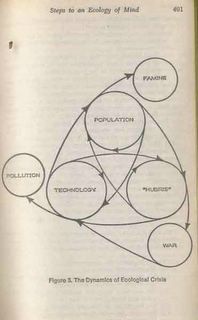
Gregory Bateson pointed out in testimony on behalf of the University of Hawaii committee on Ecology and Man, in 1970, published in “Steps to an Ecology of Mind” as the chapter “The Roots of Ecological Crisis” that the threats to “humanity's survival are traceable to three root causes: a) technological progress, b) population increase, c) certain errors in the thinking and attitudes of Occidental culture. Our values are wrong.” His diagram is reproduced at the beginning of this post showing how all three causes are self-reinforcing systems.

Values seem the only part of this interacting system of ecological crisis that we as lowly individuals can do much about. The infinite progressions of turtles is hardly convincing in bolstering “flat-Earth” ideas, and yet the very Russian doll character of the defense resonates with a hunch I cannot quite shake that it's just the sort of coherence I require of my own worldview. Fundamentally values of kindness, compassion, cooperation, tolerance, etc.; spiritual values broadly associated with love are the turtles upon which my worldview is built.

That's a long way around thinking about the question my friend posed whether or not she can earn Bazungu Bucks by doing something about racism in America. The long way is quite silly really because something I know from boorishly making my friends go online to view this blog is that they'll never read long entries; but that's a matter for another time. Meanwhile as I've been doling out Bazungu Bucks sparingly, I wouldn't be surprised to learn that my friends can easily tell I'd be happy just to give lots away just to see if we can't find ways to spend them among ourselves. Ah, and that's a matter to take up another time too. So for now, my answer to the question my friend posed is: Yes. Changing minds about racism is indeed something of service to Africans, and in service to all humankind. I'm eager to learn more about the ways she comes up with to do just that. Certainly those hours spent will be worth the bucks.

Sunday, October 09, 2005


Babtunde Olatunji Posted by Picasa

Beat the Drum

Okay, my friends don't do blogs. Last night I visited some friends with my printed brochures about this page and even got the teenaged son of my friend to bring the blog up online to show to a friend.

The best suggestion was "Simplifiy your presentation." What I want still isn't very clear, and that lack of clarity begins with me. And so the coversation goes.

My dear friend who hates computers, but humoring me looked at the blog, began engaging me about what she might do. She said that what she'd do would probably begin with music.

She recalled how when she was a child she saw Olatunji on Captain Kangaroo and he'd made quite the impression on her and her brother. After watching the show she and her brother went outside and started banging on things.

Amazing that Olatunji was on Captain Kangaroo. I found it hard to believe really, so I did a Web search. In 1959 Olatunji had a hit record Drums of Passion! That's about the right time period.

Musicians are so smart to appear on children's TV shows. Emanuel Ax has a big following among the younger set at Pittsburgh Symphony concerts. I wondered aloud why that was at a performance and the person sitting next to me said: "It's because he appears on 'Sesame Street.'"

I've got to start adding links on the sidebar and one that I'm sure to add is for African Voices a foundation Babatunde Olatunji founded to aid Africa.

My African friends are amuzed when I tell them of my get togethers with friends and how we gather around a bon fire to drum and sing. I know now that Babatunde Olatunji is one of the reasons there's drumming. My friend's life was changed all those years ago when she saw a beautiful African man making fantastic drum music on Captain Kangaroo.

Babatunde Olatunji died 7:30 Am April 6, 2003 at the age of 75.

Beat the Drum

Thursday, October 06, 2005

A Gift of Time

I like blogs, unfortunately that's not an affection many of my friends share. Since the idea of Bazungu Bucks is primarily intended as a way to share— to create a network of sharing among friends, this blog may be a waste of time. Ah, and wasting time is one of the sound reasons my friends give for not having any interest in blogs.

So far, I know that at least one of my Ugandan friends has visited this blog. And a visitor familiar to me from other venues happened upon it. He made the good point: “to make a real connection still needs a lot of time and commitment.” That understanding is is another good reason to this project maybe folly. My friends simply don't have the time or commitment.

Perhaps deep in my heart I wish for many to develop a deep commitment for restoring the health of Africans, and thereby the health of all people. But closer to the surface what I hope for is that I and my friends would not habitually avert our attention when it comes to African issues. I hope we will take a little time to look and to try to understand.

I'm reading “Africa in Chaos” by George Ayittey. On the cause of Africa's crisis, Ayittey cites two camps of opinion: Externalist, who place the blame on external factors, and Internalists who believe Africa's woes are due to internal factors.

Clearly it's not very important for people in the West, who only have a little time for paying attention to what's happening in Africa, to take one side or the other in this divide between externalist and internalist. Nevertheless, it's very useful to know that there are serious people like Ayittey who argue the internalist position. It's important if for no other reason for understanding many of the Africans who live among us in our communities.

Ah, there's another problem that hampers understanding that's not really on point, but now is probably as good a time to mention it as ever: “Africa is not a country!” I've heard Africans here many times over say to well meaning Americans. Africa is four times the land mass of the continental United States and more than three times the number of people inhabit Africa than inhabit all of the USA. There are over fifty countries in Africa. It's a diverse continent.

It's often surprising for ordinary Americans to discover that African immigrants to the USA have on average the highest educational attainment of any immigrant group. But among African immigrants here in the USA are political refugees and many more who have fled from political turmoil. Africans in America have diverse views about the politics of their home countries.

Americans, especially liberal Americans, are accustomed to hearing and perhaps tacitly accepting the externalist position as the cause for crisis. “That's another fine mess you've gotten us into.” is yet another reason why we turn our attention away from African issues. It seems yet another situation that's somehow our fault without any clear way we as individuals can correct it. So we don't understand that this or that African president meeting with our president might well be a dastardly tyrant and kleptomaniac. But such meetings do not escape the attention of many Africans among us .

When I was in the tenth grade, hum let's see, about 1970, I was going to school in suburban Charlotte, North Carolina. The schools were complying with an extraordinarily controversial court-ordered desegregation plan. Among the black teachers there, most were quite middle of the road or even conservative, I suspect, but a few were more militant. (That description is best understood in the context of the times, hard to do even for those who lived through them; for example in my year book is the photo caption: “Mrs. Brewer sets a precedent by being the first teacher at South to wear a pant suit.”) Most of us kids, me anyway, found this latter group more to our liking. Ms. Thomas tearfully told her class that the pictures of starving Biafran children populating the news magazines in the day were a hoax, saying, “Africa knows how to feed their people.”

The Nigerian Civil War was real and those photos no hoax. But Ayittey in a chapter “How the West Compounded Africa's Crisis” describes a 1995 campaign spearheaded by Randall Robinson, TransAfrica's director against Nigeria's infamous military dictator General Sani Abacha. Three cheers for TransAfrica. Nevertheless the campaign fell short largely as a result that many black American leaders simply failed to see what a bad guy Abacha was.

Inept and horribly corrupt regimes escape our attention; it's too hard to keep track. Still America's collective blind spot about Africa allows our homegrown scoundrels free reign. The intersection of filthy lucre and politics is something perhaps we here in America are being to scratch the surface of. FEMA, after hurricane Katrina, listed Pat Robertson's Operation Blessing at the number two spot for donations on their Web site. Juan Gonzelez provides a little background on Operation Blessing and Robertson's lucrative connections to African despots. The Haliburton Nigeria bribery scandal has faded from the news, in fact never seemed to garner much attention. But I wasn't surprised to see Jeb Bush seemingly involved in the matrix too.

What was I supposed to be talking about? Ah yes, time, our time to focus on Africa. Ayittey charmed me with a personal story in the Prologue to his book:

“Pure, unadulterated mischief was our credo in those early years. My younger sister, Sherry, who was in the same class, outperformed me academically. She often placed ninth in the class while I struggled at twenty-eighth position. Of course, I was never found wanting of a battery of self-serving rationalizations. “The teacher liked her,” “My dad gave her more pocket money,” “You can't learn much with only one textbook to share with thirty-one others,” “A class under a tree is ridiculous” were some typical excuses. But then there occurred an event that completely changed my life.

One evening, an uncle named Paul came to visit us at home. Uncle Paul was an affable but stern type. He shepherded an older brother, Caleb (who is now deceased), and me into a room to teach us spelling. The grumbling and foot-dragging were not muted. To overcome that reluctance, he promised the equivalent of 25 cents to the one who could spell “Mississippi” and “hippopotamus” the next day. Back them, in the 1950's that would buy two meaty candy bars or a whole meal of fried plantains and bean stew.

The following day Caleb failed the spelling test. He had lost his exercise book, he lamented. Upon being called, I stumbled a couple of times but successfully managed to spell the words. Much to my astonishment, Uncle Paul, true to his word, gave me 25 cents.”


Dr. Ayittey completed his Ph.D. Studies in Economics at the University of Manitoba (Canada) with an overall grade point average of 4.00. Ayittey goes on to make the more general point that: “[G]iven a carefully crafted system of incentives and a conductive intellectual environment, the black African mind can develop."

Most of us probably easily relate to his personal story. Uncle Paul was a family member. But the families of so many African children are so stressed that too many children don't have someone to pay them such attention. Could one of us make a such a difference in a child's life?

The ways of earning Bazungu Bucks are limited only by your imaginations. Don't underestimate what a little of your time can mean. And by all means tell us about what you do and discover.