Tuesday, February 12, 2008

Red Hand


February 12th is Red Hand Day "an annual commemoration day created to draw attention to the fate of children who are forced to serve as soldiers in wars and armed conflicts. The aim of Red Hand Day is to call for action against this practice, and support for children who suffer from this severe form of child abuse."

For an American of a certain age, February 12th is also Lincoln's Birthday, his 199th birthday. Washington and Lincoln are the two most celebrated American presidents. Both were born in February, so the government a while back decided that holidays needed to be "reformed" so they always happen on Monday--with a few exceptions--so a new holiday, President's Day--was invented. This reform safely removed politics from our veneration of presidents.

In the olden days, we children would sometimes memorize, and almost always heard recited Lincoln's Gettysburg Address on his birthday. Sometimes also older children would read or recite Lincoln's Second Inaugural Address as well.

The Lincoln Memorial is perhaps one of the most recognizable American landmarks. On the walls surrounding Daniel Chester French's sculpture of a seated Lincoln with a pensive expression are the words of the Gettysburg Address and his Second Inaugural.

Until the Civil Rights movement most black Americans voted for the Republican Party, because Lincoln was a Republican. That's one reason of course, but also in the industrial North the Republican party was the party of business. Being registered as a Republican was in many cases a prerequisite for a black person's employment. The move from the Republican to Democratic party coincided with the Republican party's move to embrace and expand state sponsored racial discrimination. Kevin Phillips is an author and once political strategist. He popularized what's known as the Republican's Southern Strategy; the old and often imitated political strategy of exacerbating ethnic tensions to polarize the electorate. Phillips is now a critic of the Republicans.

Republicans have spent their power during the last forty years at once disparaging government and vigorously expanding the military as the essential function of government. Lincoln's vision of a nation "dedicated to the proposition that all men are created equal" ..."and that government of the people, by the people, for the people, shall not perish from the earth" is inconvenient and somewhat embarrassing to the ruling ethos of the day.

Modern Republican leaders like George W. Bush, John McCain, Willard Romeny, Mike Huckabee, all celebrate a submission to "faith" and a return to racist values. That certainly does not imply that Democrats embrace individual freedom, political democracy, the rule of law, human rights, and cultural freedom, hallmarks of liberal values--hat tip Arthur Schlesinger, Jr. for the list. The evidence for the illiberal constitution of today's Democrats was on display today when 19 Democratic party senators joined without any Republican dissent in passing a surveillance bill.

The political discourse in the USA today is still colored by the War in Vietnam. In 1985 British musician Paul Hardcastle produced a innovative record called 19 (YouTube video) using samples of a television documentary on Post traumatic Stress Disorder. The statement "their average age was nineteen" is repeated throughout the song. Many have sought to declare that statistic a "myth" bumping the age up a couple of years based on casualty statistics. What seems clear from the more than 4,000 confirmed casualties by the U.S. Central Command in Afghanistan and Iraq is their average age is considerably older than 19. These pages are at Military City are worth a visit, lest the statistics blind one to the reality that there are real men and women who make up those numbers.

After the War in Vietnam the U.S. Military went to a professional force abandoning the conscription into the military. In the many arguments for the occupation of Iraq, the casualties are dismissed with: "They knew what they were getting into when they joined up." I suppose the shift to a professional military is an advance, certainly it is a change in the way we conduct war. The Iraq War has also been the impetus for an unprecedented transfer of national treasure to corporations of mercenary fighters. Crossed Crocodiles recently linked to two important papers about armies for hire. This transfer of military to globalized corporations is seems a logical extension of this professionalizing of armed combatants.

Such professionalizing really hasn't entered the public consciousness. It's still quite common to hear people talk about "our boys over there." I don't think it's an accident, or just a turn of phrase. Somehow, still in our minds is the notion that war is a ritual sacrifice of children. The American Civil War was a boys' war. So even with our professional military we still imagine soldiers as boys, just like in the Civil War, even while we condemn the barbarity of the use of children as soldiers. And even as our waring kills non-combatants, a handy way of disguising that among those we kill are children.

Tom Engelhardt wrote a piece about U.S. bombing in an agricultural city in Iraq, Arab Jabour, in January this year. Th U.S. military dropped nearly 100,000 pounds of explosives on the area. Engelhardt entitled his piece, Looking Up: Normalizing Air War from Guernica to Arab Jabour. The German's dropped 100,000 pounds of explosives on a Spanish town called Guernica. Pablo Picasso painted perhaps his most famous work to commemorate the savagery of the bombing of Guernica. A tapestry of this famous work hangs at the entrance to the Security Council room at the United Nations, a reminder of the horror of war. Yet as Englehardt points out in Iraq, in Arab Jabour, such bombardment is now routinized, so received bare mention in the press.

I was born in the one hundredth anniversary year of the end of the American Civil War. Just a couple of years after the ceasefire in the Korean War and a few years before the American fighting began in earnest in Vietnam. My boyhood was soaked in war.

Of the hundreds (probably thousands) of racist videos up at YouTube quite a few use the songs of Johnny Rebel. Johnny Rebel has staged a comeback since 9/11. As for his success he says it's all for professional reasons:
"I used to think I was prejudiced. I am not prejudiced," he continues. "If you are prejudiced, you don't like all races. Well, I don't have anything against all races ... They asked me to do it, hell, I did it. I would do anything to make a buck. Hell, I made a few bucks off of it."
From his Web site you can see how a professional makes a buck.

May 1, 2003 president Bush declared "Major Combat Operations in Iraq Have Ended." Five years later it's not clear why we're occupying Iraq, or even who we're fighting. But we're assured that the "surge" worked so well that troop reductions will be delayed.

Last week Will.I.Am of the Blackeyed Peas put up a video based on a speech by Barak Obama called Yes We Can yesterday a parody using the same idea but with John McCain's speeches called john.he.is. A second effort parodied the Yes We Can video with No, You Can't. A recent comment by rapske50 on the Yes We Can video captures the moral reasoning of Americans for John McCain:
nah man, george bush is fighting terrorists, obama wants to make them friends so they can stab us in the back. fuck obama cos he hates freedom and what it means to be american. I AM PROUD OF MY COUNTRY i dont want it ruined by muslims and wanna be muslims
Frankly, I'm not so sure a president Obama will bring our occupation of Iraq to an end. But I do believe that a president Obama will be called upon to make a case for staying. I can't envision that a president Obama will be comfortable making such an explicitly racist argument for it. And I can't imagine that McCain can make his case without such arguments, oh so carefully coded.

My hands are red, as an American my hands are red.

I deplore the conscription of children into armed combat. Have you seen pictures? Have you seen pictures of children whose lips and ears were cut off with a knife. Left alive as a reminder to other kids. Or drawings made by child soldiers depicting how family members were killed and cooked in pots in front of them? The International Action Network on Small Arms has a great page with links to dozens of organizations working on the issue of child soldiers. Our collective efforts can make a difference.

But I do not see how as an American I can truly make a difference unless the unreasonable immorality of conduct of our military operations is addressed straightforwardly: That the racist ideology which animates our conduct is named and called out. War is hell, and we deceive ourselves to imagine our conduct as virtuous.

Lincoln in his Second Inaugural Address was clear about the root cause of the American Civil War:
One-eighth of the whole population were colored slaves, not distributed generally over the Union, but localized in the southern part of it. These slaves constituted a peculiar and powerful interest. All knew that this interest was somehow the cause of the war.
He was also clear that neither side was pure in its intentions:
Neither party expected for the war the magnitude or the duration which it has already attained. Neither anticipated that the cause of the conflict might cease with or even before the conflict itself should cease. Each looked for an easier triumph, and a result less fundamental and astounding.
We as a nation have yet to come to grips with the cause of the War in Iraq. Like the Civil War it has spiraled in a way we never anticipated, expecting "an easier triumph." McCain promises a war whose end is never in sight. Obama talks of hope. The choice between the two is an easy one: I'll choose hope.

But a resolution to this conflict will not come until we as a people are wiling to confront the cause of this war and to name it. We would do well to remember the words of Lincoln now:
With malice toward none, with charity for all, with firmness in the right as God gives us to see the right, let us strive on to finish the work we are in, to bind up the nation's wounds, to care for him who shall have borne the battle and for his widow and his orphan, to do all which may achieve and cherish a just and lasting peace among ourselves and with all nations.
Longing for peace is patriotic.

Wednesday, February 06, 2008

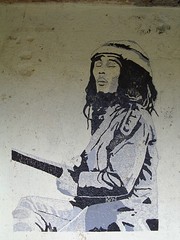
Bob Marley


Abribus Houaïlou-Bourail
Originally uploaded by menfes qeddus


February 6th was Bob Marley's birthday. I was alerted to this by a post by Rethabile at Black Looks this morning. So I've been thinking about Bob Marley all day long. I'd saved a URL that Rethabile linked to at Geoffrey Philp's Blog Spot. I'm just blown away by Philip's writing about Bob Marley. Philip is a master at using hyperlinks to inform, so his birthday post opens a world of very smart writing that's a pleasure to read.

I was not familiar with Geoffrey Philip's blog or his other writing. I wanted to be sure to credit the blog where I found the link, but I couldn't remember immediately where I got the link, so I searched Technorati. There I saw that Janie Mendes-Franco blogged Geoffrey Philp's post. It's unethical to do but here's what Janie Mendes-Franco wrote in its entirety:
Jamaican Geoffrey Philp realised early on that “good writing, like a good life, cannot be built solely on negation” - and credits that awareness to Bob Marley's “ability to transform through word-power the consciousness of a generation and to show how life-affirming values could be transmitted in poetry through rhythm and metaphor”.
If you like Bob Marley's music, or you think that Marley was saying something, but not sure what it was, then visit Geoffrey Philp's Blog Spot. You'll be glad you did.

Reflecting on Bob Marley today, first of all was the reminder how fast time has flown. I don't really feel that old, but have had some years, and my love of Bob Marley's music takes me back. The song which stuck in my head today was Burnin and Lootin. This YouTube video Burnin and Looting Tonight shows Marley playing the song and a recording of him talking about it. Marley says:
It's not really talk about burnin out the city, or burning down. But burnin out certain things in our minds to live in I-one harmony.
It's hard to say exactly, I probably heard the album Burnin' because of the popluar Eric Clapton cover of I Shot the Sheriff. I'm pretty dense, still I got the implication that Sheriff John Brown was white, but the deputy black. I'm not sure really about which version I heard first, Clapton's or Marley and the Wailers. I do remember that Burnin' and Lootin' was a visceral experience and scary for a middle class white guy. It was and still is hard to listen to Burnin' without feeling outrage.

The track right after Burnin' and Lootin' is Put It On
No more cryin';
No more cryin';
No more cryin'.
Lord, I thank you;
Lord, I thank you.
The sense of gratitude becomes all the more palpable after Burnin' and Lootin' and with that the deeper meaning of Burnin' and Lootin', "Burnin out certain things in our mind to live in I-one harmony" played on me.

The civil strife in Kenya weighs on me. To see pictures of young people feeling so alive as they commit violence, is at once abhorrent to me, but then again the rush of power isn't so foreign to my imagination. Bob Marley's music is sacred; sacred in the sense I learned as a boy in catechism class. A sacrament is "an outward and visible sign of an inward spiritual grace." The violence in Burnin' and Lootin' isn't a metaphor. The transformation
We gonna be burning and a-looting tonight;
(To survive, yeah!)
Burning and a-looting tonight;
(Save your baby lives)
Burning all pollution tonight;
(Pollution, yeah, yeah!)
Burning all illusion tonight
(Lord-a, Lord-a, Lord-a, Lord!)
is real and inside us.

Our creativity can be used to release us from the grip of desperation. My last post suggested that songs could help lead the way out of the darkness to the daylight. Surely, I understand how exasperating such comments must sound. Even here in the USA my politics of Kumbaya get mocked, and even I have to smile at my naiveté. I'm no Bob Marley. I am most grateful Marley lived. And I'm thankful that Rethabile thought to honor Marley's birthday and directed us to Geoffrey Philip's brilliant writing.

Sunday, February 03, 2008

Black History Month


The ground hog oracle, Punxsutawney Phil saw his shadow and predicts another six weeks of winter. No surprise, February is a cold month in these northern latitudes. A not so foolish American February tradition is Black History Month. Like everything else that touches race in America the tradition is controversial. The controversy cuts in a number of ways. Perhaps most controversial is that people's history is history at all. For some history means, and will always mean, stories of great men and their battles. Some simply cannot imagine that ordinary people living their lives made history. I like Black History Month because it demonstrates annually that Yes We Can!

Watching the events unfold in Kenya has filled me with sorrow. It's been a help that bloggers have been writing about the events, and that adds to the feeling. When I read a couple of bloggers who I admire and hold in high esteem, fret that they feel like they are "fiddling as Rome burns" sent a twinge of pain up my side. Some of that pain is not for Kenya, but a recognition of my own feelings of impotence to rise to the challenges of the cruelty carried out under my flag.

In my own queer mind "fiddling" reminded me of freedom songs and the confidence that far from being something trivial, these songs of freedom are essential for creating a world we want. So my thought turned to Fanny Lou Hamer a brave and great hero in American history.

There's a very good telling about Hamer's struggle here and the context is worthwhile going there to read. Here I'll copy a snippet from her testimony at a Hearing of the Select Panel on Mississippi and Civil Rights entered into the Congressional Record in 1964. Through the early 1960's Hamer sought to register to vote and to encourage other black people in Mississippi to register as well. For those efforts she and her family suffered vicious reprisals. Here's some of what happened with her arrest for breaking no law:
“A white officer said to me, ‘You are under arrest. Get in the car.’ As I went to get in, he kicked me. In the car, they would ask me questions. When I started to answer, they would curse and tell me to hush, and call me awful names.

“They carried me to the (Montgomery) County jail. Later I heard Miss Ponder’s voice and the sound of kicks. She was screaming awfully. “Then three white men came to my room. A state highway policeman (he had the marking on his sleeve) asked me where I was from. I said, ‘Ruleville.’ He said, ‘We’re goin’ to check that.’ They left out. They came back and he said, ‘You’re damn rightl!’

“They said they were going to make me wish I was dead. They had me lay down on my face, and they ordered two Negro prisoners to beat me with a blackjack. That was unbearable. It was leather, loaded with something.

“The first prisoner beat me until he was exhausted. Then the second Negro began to beat. I have a limp. I had polio when I was about six years old. I was holding my hands behind me to protect my weak side. I began to work (move) my feet. The state highway patrolman ordered the other Negro to sit on my feet.

“My dress pulled up and I tried to smooth it down. One of the policemen walked over and raised my dress as high as he could. They beat me until my body was hard, ‘til I couldn’t bend my fingers or get up when they told me to. That’s how I got this blood clot in my left eye — the sight’s nearly gone, now. And my kidney was injured from the blows they gave me in the back.”

She was left in the cell, bleeding and battered, listening to the screams of Ann Ponder, who was being beaten in another cell, and hearing the white men talk of “plotting to kill us, maybe to throw our bodies in the Big Black River, where nobody would ever find us.”
Her injuries were permanent and disabling, leading to her famous remark: "I'm sick and tired of being sick and tired" which became her epitaph. Fanny Lou Hamer was unbowed and continued her registration efforts.

Such courage is hard for me to imagine in myself. I wonder how she managed? Not finding links to prove it, but I'm sure I've read how Fanny Lou Hamer on the buses she organized for taking people to courthouses to demand their right to register to vote, she was always the first to initiate singing of freedom songs.

As a white American, so much of what I love about our culture is steeped in Africans in America, and music I love so much. After that severe beating Hamer persisted. At the time in the news "militant" was the word used in the press for people like her, but in fact she was dedicated to non-violence, "uppiddy Negroes" rolled off the lips of white people in the street. The songs she sang encouraged her. Imagine after such a beating that she went on with even more determination! Many of the songs acknowledge suffering, and don't ignore the fear we all feel, but the songs connect people to something larger, to a vision of community and a good world in which to live.

The Black Eyed Peas Obama video draws on freedom songs. The song was inspired by a speech which Barak Obama made after the New Hampshire primary election, and Obama's speech was in turn inspired by the songs which also inspired so many ordinary Americans, and extraordinary Americans like Fanny Lou Hamer. American politics has many nuances and complications, it's easy to get thick into the weeds. That Barak Obama is a politician from Illinois for example is rich with particular historical associations and meanings not quickly explained. Politics are never really pure. But there are ideas in politics which are wholesome and pure, and songs communicate that essential goodness.

No doubt a fiddle can sing, but songs sung with voices are easily shared. For my Kenyan friends inside and outside Kenya feeling they are fiddling while Kenya burns, lifting up your voice to sing is not trivial. Let us hear your songs, allow those of us who may, join with you in song. Pete Seeger remarked that songs are sneaky; they can cross borders. Together people of good will all over the world can claim history and make a better beginning. We care about Kenyans who are suffering now, because the struggle a good world is for all of us. Freedom songs encouraged Fanny Lou Hamer and they can inspire us with courage too.

Friday, February 01, 2008

Forward to Spring


Last night I was chatting online with a couple of friends in Uganda. I mentioned that we would have an ice storm in the evening. They both said "Sorry." I really wasn't looking for sympathy. Ice clearly can reek havoc, but I wasn't anticipating that kind of storm, rather anticipating the novelty of ice covering everything. On my way to the grocery store today, I did notice that a great white pine which I've admired many times along the route was downed by the ice. Curious because I encountered little other damage, nonetheless evidence that ice can be quite damaging.

Ice comes not with the bitter cold, but when it's warm enough to rain, yet still cold enough to freeze. I must have rained pretty hard during the night because the drainage ditch that cuts across the property was full with a Spring flow. It's colder now and a dusting of snow covers the ground. The water in the ditch has slowed, but still enough to make sounds after a long silent month of January.

Back at the turn of the century, when I was just getting used to having a computer and being online, I started writing an infrequent essays as the incompetent gardener using a list service called Topica. I'm not good at backing up my files and have lost a couple of computers. Not so long ago I thought of those essays and wondered if they were still on line. It seems they were, but can't seem to find them tonight, but I copied them then.

I am an incompetent gardener. I like gardening and would like to write more often about gardening. Icy wet days like today, when I yet again have to gather some wood to heat my house make me long for Spring. Not so far from where I live is a town called Punxsutawney, where even as I write this people are beginning to gather , around bon fires, for the occasion of Ground Hog Day. It's a funny custom brought by German immigrants, where whether or not a designated ground hog, a rather larger relative of squirrels common in these parts, sees his shadow. With that there is a prediction of six more weeks of winter, or occasionally a prediction of an early spring. I only pay attention to the local ground hog Punxsutawney Phil, but from the Wikipedia article on Ground Hog Day I see there are many other famous ground hog weather prognosticators.

The truth of the matter is that it will be cold for a while yet, but it's getting time to think about spring and the garden.

Part of my rational for copying the old Incompetent Gardener essays was the hope that I could have some ready made posts. With just a little revsion, I thought, those would make fine posts. I'm not so sure now. I entitled this post Seeds thinking I could rework a piece on seed catalogs. But the post didn't really interest me too much so I thought I start fresh and just use the list of seed company Web sites I'd put together.

Alas, if I take the idea of revision seriously, in a post about seeds I'd have to edit out that bit about ground hogs. But I just wrote that and if I edit and revise I'd never post a post. Oh well, I just changed the title of this post. Maybe I'll get around to talking about seeds another time.

Since I mentioned the ditch that drains the farm fields next to our property, I'll point to a nice Paul Krafel video posted by Michael at Wrythings called The Upward Spiral. It's quite an inspiring video and makes me think more about my gardening. It's inspiring to think that even my incompetent gardening can create something beautiful and useful.

Thursday, January 31, 2008

Books


My office is a mess. I'm not sure that making the photograph of the books by my desk look like a painting makes for a good picture, but at least it provides some distance from the stark reality of my slovenly ways.

I like books. A friend who reads more books in a month than I read in a year never has more than the five or six books she's reading at a time in her apartment. I keep books around because I don't remember the words, and need to refer to them. My memory tends towards paraphrase, and I know from experience that my paraphrasing often seriously distorts the meanings. So I read books and then keep them around so I can spend sometime figuring out what the books said. You might say I'm a slow reader and don't get around to reading as many books as I should.

I love reading on the Internet. There's some truly wonderful writing. The Web is a great place to search for information, but books are uniquely capable for orienting oneself to subjects.

I want to know more about Africa. My heart is heavy about the violence in Kenya in the aftermath of the presidential elections. I'm very grateful to the bloggers who are writing about it. And I will continue to read. But the more I read the more I understand that I need a better context for understanding and reading some books may be just what I need.

Chris Blattman has a post up African Reading List which has some good suggestions. Blattman recommends John Reader's Africa: A Biography of the Continent and I'll second that recommendation.

Dave at Siphoning Off a Few Thoughts has issued and African Reading Challenge. He's encouraging people over 2008 to read:
six books that either were written by African writers, take place in Africa, or deal significantly with Africans and African issues.
The great thing is he's making a carnival of it and encouraging people to write a post on their blog with the books they intend to read, and those are linked at his blog post. Then as readers offer reviews those will be linked to as well. There are already 14 participants signed up, so it's a great way to find lots of books to choose from. I'm winding my way through the posts. I particularly like Nyssaneala list at Book Haven.

I'm going to have to travel to my library to see what books they have available. I bet it's going to be slim pickins. It will be very discouraging if I'm not able to find six books meeting the criteria in the library! I may end up having to finally get around to reading Conrad's Heart of Darkness.

I was writing on a thread at a social network tonight. Crossed Crocodiles posted on a recent speech on African democracy delivered by Jerry John Rawlings at the 5th Annual Trust Dialog. I was impressed by the address, but went to Koranteng's Toli thinking of a particular post. I know that not everyone is as fond as I am of going back to the books I've already read. But I'm fond of doing that, and for the same reasons I'm fond of going back to read Koranteng's posts. He surely is one of the most brilliant writers on the Internet. Surfing around old posts, I realize there's no lack of suggestions of books to read there.

I haven't officially signed on to the African Book Challenge, but it's a good plan and I'm going to try to do it. Maybe once I get a couple of books under my belt I'll sign on. At least I'm going to make a list. I hope if others are so inclined they'll join in and link to their writing at the African Reading Challenge.

Tuesday, January 29, 2008

Blog Tag


That's a picture of the City of Pittsburgh Mounted Patrol, or whatever they were. Not sure who took the picture, but it was at the Pittsburgh action against the Iraq War on January 26, 2003. Of course the photo has no relevance to this post. But posting it made me go back to the press reports and there's a picture there with the caption: Veteran peace activist Molly Rush lies in the middle of Fifth Avenue during the "die-in" protest yesterday. I was disappointed not to find a great link to share about the indefatigable Molly Rush, here's a brief one.

The culmination of the march squeezed everyone into a block in front of St. Paul's Cathedral. The horse patrol blocked that egress and the others were blocked by scores of police vehicles. It was a very cold and snowy day. With the initial speeches and the March I was darn cold buy the time we were standing in front of the cathedral. Then Molly Rush and a small group, primarily old women, lay down on the pavement to commence a die in. I didn't wait around but talking to a police officer later she said that the group lasted more than two hours motionless on the ground.

I'm not a fan of blog memes because strangely I can never think of anything to say and am not good at making lists. Daisy of Daisy's Dead Air tagged me with two memes. The first is: five things you regret and five you don't. I'm bad with lists and so will have to pair it down:

I regret my long love affair with tobacco.

I don't regret the cats and my lovely dog, Sheila, sharing their lives with me.

I would probably have ignored the tagging thing, except the other meme was something that I discovered I could do fairly easily. Lady Banana tagged Daisy. Here's the deal:
Rule #1
Copy all the links below and replace a single link under the appropriate alphabet. If your domain name, or even the title of your blog, starts with an ” A,” you’d replace the link under that alphabet and put the replaced link at the bottom. Also, don’t forget to credit the tagger, or where you got the list from, at the end of the list with a full URL of the post so that a pingback gets generated.


A. A Glimpse of the World
B. Bazungu Bucks
C. Composing
D. Dani Rodrik's weblog
E. Eschaton
F. find the time to rhyme
G. Gukira
H. Hats For Health
I. Insight Kenya
J. Jack Saturday
K. Koranteng's Toli
L. Learning Is Change
M. Mentalacrobatics
N. No Longer At Ease
O. Open Office.org Training Tips, and Ideas
P. Paper Forest
Q. 3Quarks Daily
R. Rootless Cosmopolitan
S. Steve Ntwiga Mugiri
T. Transition Culture
U. Uganda's Scarlett Lion
V. Vietnamese God
W. White African
X. Xylophone Building
Y. YouTube
Z. Zone5

Replaced link: Blogging With Cents
Previous tagger: Daisy's Dead Air

Rule #2You now have to “tag” at least five people and encourage them to participate so that this thing spreads like a virus. Remember, though, that not everyone’s into these kinds of things, so don’t be upset if they don’t participate. Just simply replace your tag. Remember to tag blogs only and no pornographic ones as we do want to keep the integrity as a blogging community.

I'm tagging:

Oh heavens! This is the another reason I hate blog memes. I'm not tagging, but I hope anyone who would like to will play the Alphabet Game. It's interesting to see the lists and learn some new blogs.

There's a #3 Rule too, something about asking a question, but you'll have to go visit Lady Banana if you're interested.

Monday, January 28, 2008

The Greatest Natural Clamity


I swiped the photo from this Web site because they were the only one to offer a photo credit which Google Translate helpfully renders:
1897 cattle plague raged in South Africa (image: Collection Onderstepoort)
Have you ever heard of Rinderpest? I hadn't until reading John Reader's Africa:A Biography of a Continent.
Rinderpest is a virus disease, very highly contagious, which manifests itself in fever, restlessness, loss of appetitite, blood-stained diarrhoea, and often nasal discharges. Some animals become maniacal; the great majority weaken rapidly and die.
Reader's book is really quite remarkable in providing a biography of Africa beginning with geologic and climatic detail and proceeding into human history. I found the book fascinating and engaging. Breezing through the customer reviews at Amazon you can get a sense for the problems some find; mostly the result of the sweeping enormity of the subject.

There are eight parts to the book each with multiple chapters. The brief few pages on riderpest are contained in Part 7 "The Scramble" and in the chapter "Resistance." The Scramble for Africa refers to the period between the 1880's and WWI as European powers competed to lay claim to the African continent. "Resistence" is a chapter dealing with the "tests" of colonial authority in Africa. Reader holds that a series of natural calamities "were no less influential" than the newly invented machine gun.

Reader's chapter's "Resistence" and "Rebellion" are shocking and depressing. As I read them I wondered how could it be that I'd never heard about suffering on such a scale. Somewhere I read about Adam Hochschild's impetus to write his book King Leopold's Ghost about the cruel exploitation of the people of the Congo Free State. In less than 40 years the population was depleted from more than 20 million to 10 million. He wondered why he hadn't heard about this tragedy?

I've read a few books on Africa or by Africans. I've made some African friends and follow some African blogs and Web sites. Most people have an enormous well of goodwill. It's heartening to see so many outside Africa take an interest. The more I learn, the more I understand how little I know. In order to create more collaboration for good in Africa, it's important to realize that the story we think we know is incomplete. And it's important to want to learn more.

Rinderpest has a long history, and figures prominently in Western history because outbreaks of the virus were spread by armies and their pack animals. The disease was brought to Sub-Saharan Africa first by Italian colonialist in Somalia by cattle they imported from India. The disease spread rapidly, cattle, sheep and goats were infected. The disease ravaged wild buffalo, giraffes, antelopes, and wild hogs. Reader writes:
In South Africa, drastic attemps were made to halt the advance of the disease. A barbed-wire fence, 1,600 km long, was erected from Bechuanaland to the Cape-Natal coast. Police patrolled the fence; disinfection points were established; infected herds were shot--in all, over 1 million [pounds sterling] was spent on trying to keep the disease out of South Africa, but to no avail. Two and a half million cattle died south of the fence; 5.5 million south of the Zambezi, and up to 95 percent of the cattle in Africa's pastorial regions generally.
The impacts of this calamity on people were obviously horrific. Reader cites South African scholar J. N. P. Davies in describing the rinderpest epidemic as
[T]he greatest natural calamity ever to befall the African continent, a calamity which has no parallel elsewhere.
Yet I had never heard or been told about it.

One of the connections that John Reader highlights about the great Rinderpest epizootic is that the results of the plague disrupted the ecological balance. Areas which had been grazed turned to scrub which allowed an expansion of the tsetse fly range. Tsetse flies in the process of feeding on the blood of animals transmit small single cell organisms called typanosomes. These organism create a serious disease in humans and animals, sometimes called "sleeping sickness." Reader notes that cases were reported in southern Uganda in 1902 and that the disease had killed 200,000 people by 1906.

Perhaps partly from understanding how the multiple plagues which beset Africa in the last century, we have a more ecological sense today; that everything is related to everything. One sort of side effect of thinking that everything is related is a feeling of despair that everything has unintended consequences and nothing will ever work out right.

African Agriculture is a wonderful resource for news about agriculture in Africa. The contact is for the blog is Chido Makunike, a Zimbabwean living in Senegal. The recent roundup of articles links to an article in the Seattle Times, Gates Foundation's agriculture aid a hard sell. The Gates Foundation along with the Rockefeller Foundation have created an initiative called Alliance for a Green Revolution in Africa, AGRA.

The Seattle Times article summarizes some of the criticism of the initiative:
But the foundation's nascent agricultural program is encountering more resistance than much of its other work, with critics concerned that its market-oriented, technology-centric approach will open the door to big agribusiness interests and genetically engineered food.
The answers to that criticism in the article and also gleaned from the excellent AGRA Web site impressed me and calmed some of my concerns.

The question is whether The Green Revolution is the right model. It's a good question, a question that bumps up against the difficult area of morality.

Steven Pinker had a widely linked to article in the New York Times Magazine earlier in the month called The Moral Instinct. It's a good article to check out for a number of reasons, but I mention it because Pinker points to Norman Borlaug as someone who's "most admirable." Borlaug is a plant scientist who's been called "the father of the Green Revolution." Borlaug also established The World Food Prize.

In 1999 the World Food Prize was awarded to Dr. Walter Plowright; from the WFP site:
Dr. Walter Plowright was recognized for his development of a vaccine that has resulted in the elimination of rinderpest, commonly known as cattle plague, from most regions of the developing world. His research has provided a practical means to re move a menace dating back 16 centuries.
The effort to irradiate rinderpest permanently by 2010 is ongoing, but realistically possible.

Pinker makes the case that it's very important to understand our habits about morals. He writes:
Our habit of moralizing problems, merging them with intuitions of purity and contamination, and resting content when we feel the right feelings, can get in the way of doing the right thing.
It's easy to say that we ought to strive to do the right things, but much harder in practice.

People must develop more ecological ways of thinking, to better imagine how the relationships which make are world are composed and interact. A part of that is understanding this ironic quality of moralizing can cloud our clear thinking and get in the way of doing good. That nowhere around the globe should the suffering caused by the rinderpest epizootic ever happen again is a good goal. That nowhere on the globe should people starve is a good goal too. How to achieve these goals and hundreds of others is the essential challenge for our time. To meet the challenge we must imagine that we are indeed capable of creating something good even while uncertain that we've hold all the answers.