Showing posts with label Kenya. Show all posts

Thursday, March 25, 2010

Tech and Kenyan Blogs


Oh heavens, I haven't been around at this blog for a long time. Like every space I inhabit, its in dire need of cleaning up. For the time being, excuse the clutter.

The impetus for this post comes from a post at The Black Campaign, Tech Killed the Kenyan Blog. It was cross-posted to A Kenyan Urban Narrative and the comments seem better there. Njorge Matathia has slightly different voices for the two blogs, and The Black Campaign might be his "yuppie" voice, while A Kenyan Urban Narrative the voice of Potash champion of ordinary Kenyans. Anyhow, the post fits both places well, as it begins with:
Days I miss: when Kenyan blogs were about stories. The politics of every day- the Kenyan way of life relived by voices hitherto unknown- and not big politics.
I posted one of my too long comments on his subsequent posts and he wrote me an email suggesting that I do my own blog post--very tactfully I might add. The picture is a screen shot of Trevor Horn of the Buggles from their 70's music video Video Killed the Radio Star. Back in those days the question was Beta or VHS--rival videotape formats. It wasn't so much that videos were new, but that people could record videos on a home machine to video tape. Technology advances, but it's never easy to predict what the ramifications of technology will be.

I like the edition of the post at A Kenyan Urban Narrative because that blog goes back to the times Potash is nostalgic for, and most of those who left comments there do too. A shared history is a big part of stories.

Matathia remembers the early day of Kenyan blogs when people were telling stories and linking to each other's blog posts. He writes of that time:
The parochialism was not only charming, it put fluency and local colour into the blogs and for one moment a pastiche of an immensely stratified and arbitrary nation called Kenya was starting to emerge.
He laments the passing of a a truly Kenyan-flavored network :
The pan-African curators or the African Internet’s power axis- chugging deux ex machina like in the background, all along- came to the fore and absorbed the Kenyan blogosphere into a broader African Internet narrative.
The common ground of this new narrative is around technology.

Of course the Kenyan context is particular, but there's a general issue of how to knit communities together and what role technology plays. In the the state of Vermont in the USA is a forum to knit at the very local level called the Front Porch Forum. We'll see lots more efforts to encourage such very local communications online. A part of these efforts are tech issues, but the bigger part are community issues. The good old days of the Kenyan Blogs weren't so local as the Vermont Front Porches and many writers imagined an even wider audience. Still, in having come together for a time there was a body of particularly Kenyan content online which coincided with more Kenyans accessing the Web. But now there is so many more venues for content what's missing is perhaps the sense that these sites present a uniquely Kenyan voice.

To promote their second studio album 82 the "experimental boy band" Just a Band uploaded a film to YouTube Makmende Returns highlighting the track "Ha-He" from the album. At Facebook the JaB fan page has about 3,659 fans. The Makmende fan page has got over 17,000 all in about a week's time. I don't have the patience to scroll through the fans, but it looks to me the majority are Kenyan. The YouTube video has about 23,000 views as I look tonight. I suspect that it's not so easy for people in Internet cafes in Kenya to watch the video at YouTube. I'm really curious if the video has gone viral in Kenya, and how? All their videos are cool. Makmende is particularly enjoyable to me because I'm old enough to remember the 70's when the Blaxploitation movies the video appropriates were popular.

Just a Band are multi-media artists. Matathia raises the point in his post that part of what did-in the Kenyan blogs was that the curation of them somehow escaped Kenyan borders. JaB is an example of artists using online social media effectively, and to an extent "effectively" means not holding on too tight but allowing the content to flow. I'm not sure for example that hundreds of Makmende jokes posted a day is sustainable, but the fan page will live on. Part of the appeal of blogs is the commitment to them is over a longer time than fan pages require. Perhaps the difference in numbers at Facebook between JaB's fan page and the Makmende fan page has to do with the sense that the jokes at the Makmende page won't be fresh forever so might as well be enjoyed "in season." In the present it's a gathering place for Kenyans all over.

Update: Ethan Zuckerman Makmende's so huge, he can't fit in Wikipedia

In the Kenyan blogs today perhaps the Gay blogs come as close to the sort of community that Matathia laments passing. Those blogs certainly are not overly concerned about tech subjects--although in general it seems that blogs by Africans are quick to adopt useful widgets. While these bloggers talk mostly about the scene in Kenya, certainly they also keep and eye out for a pan-African perspective. And no matter what the content of blogs or where they are written, it's a feature not a bug that people everywhere can blunder into them. Yet gay-themed blogs are perhaps too parochial in the sense that Kenyans looking for Kenyan content can easily by-pass them never really knowing they exist. There probably are many other subset of Kenyan blogs I don't know about.

Afrigator is a way to discover Kenyan blogs. Also since the blogs are rated by popularity it seems to provide some data to test Matathia's hypothesis about the tech take-over. I'm not sure how to do that somewhat objectively, but just pursuing the blogs I'm left with and equivocal yea and nay.

Matathia writes:
The death of Story came when Bloggers turned into professionals- Internet authorities. Suddenly the broadcaster and his equipment became more important than the broadcast.
Looking over the top blogs at Afrigator does to my mind reinforce the idea of "Internet authorities." There are almost 700 Kenyan blogs listed and I think since people sign up for Afrigator there's probably a selection bias towards tech-savvy people there.

I'm not so sure about the equipment becoming more important than the broadcast. Part of the problem is "broadcast" really doesn't quite describe what's happening with the new technologies. Bloggers are often putting content on different channels, like Facebook. But all of the channels also have feedback options so that readers can engage. Online content is peer to peer, many to many, so not quite like broadcast as we are used to thinking of it.

Facebook makes connections visible. Just in a cursory way I was looking at a few profiles linked from Kenyan blogs to Facebook and discovering that quite often mutual friends show up. I've never been to Kenya and am not especially connected so this surprises me. It is true that often the links are cyberactivists, For better or worse my connections have endured hearing my stories and I've heard stories too. I think that less than a hand full of my network at Facebook is from knowing people through the blogs they write. There are many venues for telling stories now.

One conclusion following from the observation that I, some random white guy in Western Pennsylvania, seems to have at least one connection made visible to the Kenyan blogosphere, is that the online world really is small. Potash with A Kenyan Urban Narrative surely has tried to provide a voice for those seldom heard. He admits that lots of regular folks are using Twitter and Facebook now and wants them to up their game, going beyond banal descriptions of their day-to-day towards the meanings they discover. Blogging for most requires more time than the 15 and 20 minute bites on the Internet most people buy. The short tweets, status updates and jokes are enough to say "I'm here!" and provide more bang for the buck. Some of my contacts to the Kenyan blogosphere are Western activists, but others are Kenyans who collect characters online.

Online participation in many frameworks to model it have watchers at the base. the simple observation that many more people will see something you put online than respond to it in a visible way. Beth Kanter provides a more descriptive framework from Forest Social Technographics: watching, sharing, commenting, producing and curating at the top. I'm no tech maven, but Matathia pins the blame on the demise of stories on Kenyan blogs not just on "Tech" but also with the curation of blog content. So I want to think aloud a bit more about curration, and who the curators might be.

Valdis Krebs uses social network analysis and blogs about it at TNT-The Network Thinker. In this post he provides a very simple diagram of a network and asks about it: "Where would you put your message?" The post gets rather involved, but a simple message is that very connected people aren't just the people who are so obviously connected. The Forest framework of course is about connections and the base who simply watch and don't post also don't curate much, but the other actions: sharing, commenting and producing seem to me to contain a bit of curation in them.

When I looked at my Facebook connections to prominent Kenyan bloggers one of my most productive links is a Kenyan fellow, I won't name in case to offend him. He doesn't blog and I don't see him putting much up at Facebook. I know him from the old Omidyar social network and now Ned. He's most active there participating in recreational games an posting an occasional wry comment in threads. Our direct correspondence isn't too extensive, yet we both know about each other from watching posts, and I think we are both what others might call slightly off-beat characters. I don't know him from comments on Kenyan blogs I read, although it's quite possible he uses an Internet handle; it's also possible that he doesn't comment much on them which is what I suspect is the case. Nevertheless, in looking at my social network as revealed by Facebook, he's one of my most direct connections to it.

Topping the framework modeling online engagement with curation implies there are very few curators. Probably the number of people who identify as curators online is few in number. And I think most of us do think there ought to be more sites online that join together various content in unique ways. Curation is also a collective activity. Just a Band is a great band and they bring together creative people in producing wonderful videos and shows. I'm sure they knew in advance that their promotional video staring Makmende would get attention, but it seems the popularity of the Facebook Makmende fan page probably came as a surprise. Just in my dilly-dallying with this post the number of fans has increased from 17,000 to 25,000 and counting--eight times the number of fans on the JaB fan page. I don't think all these people are new fans of JaB, but rather joining in the fun of Makmende is what enticed them to go a step further than just watching.

The length of this post is a good sign that I've not gotten around to making any point, so summing up is pointless, nevertheless her goes: One of the points I thin Njorge Matathia makes in his post is that the wide variety of venues for posts has diluted the availability of Kenyan stories online. Everyone got so interested in the tools that they forgot the stories. But the tools have changed the stories being told too. Blogs are still one of the best ways for people to make pages to share online with others. Facebook is getting lots of new folks accustomed to putting stuff online, and when it comes to making pages they might well choose to do it there. There are advantages to blogs versus the walled-garden sites. I like very much that Potash and Njorge use Facebook to get people to his blog because it demonstrates some of these advantages. One of the big advantages of blogs is there are hundreds of great Kenyan blogs all with social networks that often touch Facebook but expand beyond it.

There is also a point that I haven't addressed, as this post is too long already won't in any depth right now, that can be stated as a question: "How is an artist to make money nowadays?" JaB provides some clues of what it is to make something of a living from music, but written works, story authorship isn't just the same. I'll talk about this problem in a subsequent post.

Wednesday, February 06, 2008

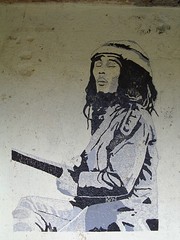
Bob Marley


Abribus Houaïlou-Bourail
Originally uploaded by menfes qeddus


February 6th was Bob Marley's birthday. I was alerted to this by a post by Rethabile at Black Looks this morning. So I've been thinking about Bob Marley all day long. I'd saved a URL that Rethabile linked to at Geoffrey Philp's Blog Spot. I'm just blown away by Philip's writing about Bob Marley. Philip is a master at using hyperlinks to inform, so his birthday post opens a world of very smart writing that's a pleasure to read.

I was not familiar with Geoffrey Philip's blog or his other writing. I wanted to be sure to credit the blog where I found the link, but I couldn't remember immediately where I got the link, so I searched Technorati. There I saw that Janie Mendes-Franco blogged Geoffrey Philp's post. It's unethical to do but here's what Janie Mendes-Franco wrote in its entirety:
Jamaican Geoffrey Philp realised early on that “good writing, like a good life, cannot be built solely on negation” - and credits that awareness to Bob Marley's “ability to transform through word-power the consciousness of a generation and to show how life-affirming values could be transmitted in poetry through rhythm and metaphor”.
If you like Bob Marley's music, or you think that Marley was saying something, but not sure what it was, then visit Geoffrey Philp's Blog Spot. You'll be glad you did.

Reflecting on Bob Marley today, first of all was the reminder how fast time has flown. I don't really feel that old, but have had some years, and my love of Bob Marley's music takes me back. The song which stuck in my head today was Burnin and Lootin. This YouTube video Burnin and Looting Tonight shows Marley playing the song and a recording of him talking about it. Marley says:
It's not really talk about burnin out the city, or burning down. But burnin out certain things in our minds to live in I-one harmony.
It's hard to say exactly, I probably heard the album Burnin' because of the popluar Eric Clapton cover of I Shot the Sheriff. I'm pretty dense, still I got the implication that Sheriff John Brown was white, but the deputy black. I'm not sure really about which version I heard first, Clapton's or Marley and the Wailers. I do remember that Burnin' and Lootin' was a visceral experience and scary for a middle class white guy. It was and still is hard to listen to Burnin' without feeling outrage.

The track right after Burnin' and Lootin' is Put It On
No more cryin';
No more cryin';
No more cryin'.
Lord, I thank you;
Lord, I thank you.
The sense of gratitude becomes all the more palpable after Burnin' and Lootin' and with that the deeper meaning of Burnin' and Lootin', "Burnin out certain things in our mind to live in I-one harmony" played on me.

The civil strife in Kenya weighs on me. To see pictures of young people feeling so alive as they commit violence, is at once abhorrent to me, but then again the rush of power isn't so foreign to my imagination. Bob Marley's music is sacred; sacred in the sense I learned as a boy in catechism class. A sacrament is "an outward and visible sign of an inward spiritual grace." The violence in Burnin' and Lootin' isn't a metaphor. The transformation
We gonna be burning and a-looting tonight;
(To survive, yeah!)
Burning and a-looting tonight;
(Save your baby lives)
Burning all pollution tonight;
(Pollution, yeah, yeah!)
Burning all illusion tonight
(Lord-a, Lord-a, Lord-a, Lord!)
is real and inside us.

Our creativity can be used to release us from the grip of desperation. My last post suggested that songs could help lead the way out of the darkness to the daylight. Surely, I understand how exasperating such comments must sound. Even here in the USA my politics of Kumbaya get mocked, and even I have to smile at my naiveté. I'm no Bob Marley. I am most grateful Marley lived. And I'm thankful that Rethabile thought to honor Marley's birthday and directed us to Geoffrey Philip's brilliant writing.

Sunday, February 03, 2008

Black History Month


The ground hog oracle, Punxsutawney Phil saw his shadow and predicts another six weeks of winter. No surprise, February is a cold month in these northern latitudes. A not so foolish American February tradition is Black History Month. Like everything else that touches race in America the tradition is controversial. The controversy cuts in a number of ways. Perhaps most controversial is that people's history is history at all. For some history means, and will always mean, stories of great men and their battles. Some simply cannot imagine that ordinary people living their lives made history. I like Black History Month because it demonstrates annually that Yes We Can!

Watching the events unfold in Kenya has filled me with sorrow. It's been a help that bloggers have been writing about the events, and that adds to the feeling. When I read a couple of bloggers who I admire and hold in high esteem, fret that they feel like they are "fiddling as Rome burns" sent a twinge of pain up my side. Some of that pain is not for Kenya, but a recognition of my own feelings of impotence to rise to the challenges of the cruelty carried out under my flag.

In my own queer mind "fiddling" reminded me of freedom songs and the confidence that far from being something trivial, these songs of freedom are essential for creating a world we want. So my thought turned to Fanny Lou Hamer a brave and great hero in American history.

There's a very good telling about Hamer's struggle here and the context is worthwhile going there to read. Here I'll copy a snippet from her testimony at a Hearing of the Select Panel on Mississippi and Civil Rights entered into the Congressional Record in 1964. Through the early 1960's Hamer sought to register to vote and to encourage other black people in Mississippi to register as well. For those efforts she and her family suffered vicious reprisals. Here's some of what happened with her arrest for breaking no law:
“A white officer said to me, ‘You are under arrest. Get in the car.’ As I went to get in, he kicked me. In the car, they would ask me questions. When I started to answer, they would curse and tell me to hush, and call me awful names.

“They carried me to the (Montgomery) County jail. Later I heard Miss Ponder’s voice and the sound of kicks. She was screaming awfully. “Then three white men came to my room. A state highway policeman (he had the marking on his sleeve) asked me where I was from. I said, ‘Ruleville.’ He said, ‘We’re goin’ to check that.’ They left out. They came back and he said, ‘You’re damn rightl!’

“They said they were going to make me wish I was dead. They had me lay down on my face, and they ordered two Negro prisoners to beat me with a blackjack. That was unbearable. It was leather, loaded with something.

“The first prisoner beat me until he was exhausted. Then the second Negro began to beat. I have a limp. I had polio when I was about six years old. I was holding my hands behind me to protect my weak side. I began to work (move) my feet. The state highway patrolman ordered the other Negro to sit on my feet.

“My dress pulled up and I tried to smooth it down. One of the policemen walked over and raised my dress as high as he could. They beat me until my body was hard, ‘til I couldn’t bend my fingers or get up when they told me to. That’s how I got this blood clot in my left eye — the sight’s nearly gone, now. And my kidney was injured from the blows they gave me in the back.”

She was left in the cell, bleeding and battered, listening to the screams of Ann Ponder, who was being beaten in another cell, and hearing the white men talk of “plotting to kill us, maybe to throw our bodies in the Big Black River, where nobody would ever find us.”
Her injuries were permanent and disabling, leading to her famous remark: "I'm sick and tired of being sick and tired" which became her epitaph. Fanny Lou Hamer was unbowed and continued her registration efforts.

Such courage is hard for me to imagine in myself. I wonder how she managed? Not finding links to prove it, but I'm sure I've read how Fanny Lou Hamer on the buses she organized for taking people to courthouses to demand their right to register to vote, she was always the first to initiate singing of freedom songs.

As a white American, so much of what I love about our culture is steeped in Africans in America, and music I love so much. After that severe beating Hamer persisted. At the time in the news "militant" was the word used in the press for people like her, but in fact she was dedicated to non-violence, "uppiddy Negroes" rolled off the lips of white people in the street. The songs she sang encouraged her. Imagine after such a beating that she went on with even more determination! Many of the songs acknowledge suffering, and don't ignore the fear we all feel, but the songs connect people to something larger, to a vision of community and a good world in which to live.

The Black Eyed Peas Obama video draws on freedom songs. The song was inspired by a speech which Barak Obama made after the New Hampshire primary election, and Obama's speech was in turn inspired by the songs which also inspired so many ordinary Americans, and extraordinary Americans like Fanny Lou Hamer. American politics has many nuances and complications, it's easy to get thick into the weeds. That Barak Obama is a politician from Illinois for example is rich with particular historical associations and meanings not quickly explained. Politics are never really pure. But there are ideas in politics which are wholesome and pure, and songs communicate that essential goodness.

No doubt a fiddle can sing, but songs sung with voices are easily shared. For my Kenyan friends inside and outside Kenya feeling they are fiddling while Kenya burns, lifting up your voice to sing is not trivial. Let us hear your songs, allow those of us who may, join with you in song. Pete Seeger remarked that songs are sneaky; they can cross borders. Together people of good will all over the world can claim history and make a better beginning. We care about Kenyans who are suffering now, because the struggle a good world is for all of us. Freedom songs encouraged Fanny Lou Hamer and they can inspire us with courage too.

Tuesday, January 22, 2008

Posting Regularly


I sleep in a shack. It can get cold at night, so I sleep under a pile of blankets. That works pretty well, but I can get too hot. Getting too hot is what accounts for remembering a dream the other night. I don't often remember dreams and generally when I do they're no account.

This dream bothered me. I suppose the details really do matter, but the gist of it was that in my dream I extricated myself from a situation where strangers, I was sure, were going to do something really bad to another stranger. I escaped but was left wandering in unfamiliar surroundings.

Yesterday was the Martin Luther King holiday. I read his I Have a Dream once again, and dd posted King's last speech and that speech made me think more about the dream I had. King spoke:
Let us develop a kind of dangerous unselfishness.
He followed with a remarkable telling of the parable of The Good Samaritan. It's really worthwhile to read King's speech. King drew from the parable a lesson:
And so the first question that the Levite asked was, “If I stop to help this man, what will happen to me?” But then the Good Samaritan came by. And he reversed the question: “If I do not stop to help this man, what will happen to him?”
In my dream the first question I asked was: "What will happen to me?" and skedaddled out of harms way. Sensible enough, but I was haunted by the second question and tossed and turned trying to get back to sleep after removing a layer of covers.

Why do we need to question what will happen to that other stranger anyway? Well for one reason King so clearly stated earlier in the same speech:
Men, for years now, have been talking about war and peace. But now, no longer can they just talk about it. It is no longer a choice between violence and nonviolence in this world; it’s nonviolence or nonexistence.
It's forty years now and the urgency of that existential terror is even plainer now. Naturally, I care very much about my own existence, but my end is a puny consequence in the bigger view of a our collective doom.

The markets opened today with a pretty clear sense that our financial crisis is a big deal. So there's been plenty of gloomy posts to read in the blogs about that. Stirling Newberry in a comment on his own post today at The Agonist wrote:
Right now the international consensus is that the rich own the world and the rest of us just make trouble.
It's safe to say, seeing how I sleep in a shack, that I'm one of the rest of us. With the memory of King's speech still fresh in mind, something that Bayard Rustin said came to mind with Newberry's comment. Here's Martin Mayer writing about Rustin in The Saturday Evening Post in 1964:
"I believe in social dislocation and creative trouble," Rustin says; and within these categories he specializes in imagination and invention. The man is an artist as well as an organizer—he made his living for some years as a nightclub singer, working with Josh White and Leadbelly at the old Café Society in New York, and he could make a living tomorrow as an interior decorator specializing in antiques. To Rustin, a demonstration is a piece of theater which will be a memorable experience for the spectators (which is what most people are); and it is an opportunity to find a soft spot where concerted action can make a dent in society.
I may not be as creative as Bayard Rustin was, but if I'm trouble anyway, I might as well be creative.

The prodding to post regularly came from leaving a comment at a blog new to me, Daisy's Dead Air. Daisy is fine writer and creative trouble. Trouble making is dangerous, and I'm not brave. Daisy said that I need to post regularly. Although her blog is new, I know she knows we're all in bunch of trouble; I know she knows I know too. So the "need" in this admonition is we better be creative, at least; have you a better idea?

Potash is creative. Leaving his blog posting aside for other projects he's back writing about the current political crisis in Kenya. It's not just at his blog I see him, but in comments at other blogs, encouraging writers towards creative trouble. Not destructive and incitement to destruction, rather to be creative. The writers have written at Kwani?,but the servers are down, so Potash is leaving comments for writers to write and writers are writing.

A long while ago Potash left a comment saying that as a kid he questioned Martin and Malcolm weighing in his mind their approach. The really useful discovery he told me was satyagraha the word that Mohandas Gandhi use for his philosophy of resistance. The word can be rendered in to English as grasping onto truth. Martin Luther King referred to it as "soul force." The application of Gandhi's philosophy on non-violent resistance was in part an American invention with inclusion of Christian theology. But the core of moving away from error with patience and compassion towards truth remained integral.

Opinions vary, naturally, and anything I say about the situation in Kenya as a middle-aged American needs to be taken with a grain of salt. Potash's most recent post is Why I Blame Kibaki. He echo's Stirling Newberry's observation that the powers that be see the rest of us and nothing but trouble. Like Gandhi, King and so many others well understood, Potash avers that the rest of us together cannot be ignored. Together we can create a kind of creative soul force.

Grasping towards the truth requires patience and sadly is dangerous. Not one of us wants to be battered, beaten and burned. We cannot take those dangers lightly. While violence may sometimes offer some protection to us individually, together violence will only perpetuate the human folly that's gotten us into this mess in the first place. We can't dismiss the danger; King clearly knew. Yet in calling us to develop a "dangerous unselfishness" his words are empowering. We've got soul force, bigger than any of us once we turn the question around from "What will happen to me?" to "What will happen to him?" We're in this world of trouble together and it's only grasping that soul force as creatively as we can that will get us trough.

Saturday, January 12, 2008

Resentment and Forgiveness

Two by two, often there are pairs of words that share a deep relationship, opposites perhaps. Kenya is currently in a political crisis causing widespread social disruption. As an outsider I don't know the contours of the many resentments among Kenyans. As a person, I dread further violence and destruction and long for repair and reconciliation.

Recently I read a review by Roger Scruton of a book called Forgiveness: A Philosophical Inquiry by Charles Griswold. I think forgiveness an important and difficult subject, so the review was thought provoking.

One of the criticism of the Internet is that people filter information sources so that they essential get only information from the perspective of people like themselves. I'm relatively new to the World Wide Web, coming online in the late 1990's. Almost immediately I encountered views not only opposite mine, but views seeming quite offensive. Since then RSS and other methods for filtering sources have come along. In the nine years I've been online, I've developed haunts where I gather news and views, so of course I filter.

My political tendencies lean left. Scruton is unabashedly conservative. I surely do filter political commentary towards left-leaning sources, but it doesn't seem possible to filter out conservative-leaning voices, nor does it seem desirable to me.

Likewise I'm not religious; I'm not a believer. The other evening I was through the posts answering the Edge Annual Question. The question Edge asked was: "WHAT HAVE YOU CHANGED YOUR MIND ABOUT?" After reading a half dozen entries or so, I thought to myself: "God, I love these atheists!" Easily amused I chuckled at my inconsistency. Allan Alda's piece is entitled So far, I've changed my mind twice about God. As a young man Alda decided that the idea of God didn't really make sense to him, so he considered himself an atheist. He was quiet about this belief, knowing how touchy people so often are. But after eleven year interviewing hundreds of scientists for Scientific American Frontiers, he's reconsidered his atheist identity and settled on letting the uncertainty about God be. He's changed his mind and is now agnostic about God. His post and all the post are worth reading.

It's fascinating to hear what really smart people have changed their minds about and why. It's nice too that they aren't trying to change other minds in these essays, simply how their minds have been changed. 2007 saw quiet a lot of discussion about Atheism a a number of Edge essays were about changing from believers to atheists, Alda's uncertainty stands apart. Perhaps because I'm not a scientist his position resonates with me, certainly that uncertainty is unlikely to convince anyone to change their beliefs about God.

Scruton points out that Griswold observes that forgiveness can't be achieved alone:
Forgiveness is not achieved unilaterally: it is the result of a dialogue, which may be tacit, but which involves reciprocal communication of an extended and delicate kind. The one who forgives goes out to the one who has injured him, and his gesture involves a changed state of mind, a reorientation towards the other, and a setting aside of resentment.
Often, with a straight arrow between resentment and hatred are coupled. But the possibility of forgiveness after resentment is hopeful, if not as straightforward.

On January 1st I started a thread on the Kenyan elections at a social network I attend. And I've been following many blog posts about the Kenyan situation. There are lots of opinions! While many bloggers have been actively moderating out hate speech, it's easy to find such and passion is everywhere.

Ethan Zuckerman is in the Netherlands speaking at an event, Fill the Gap, which focuses on IT in developing nations. Zuckerman in a recent post tells about Fairous Manji from Fahamu and Pambazuka News who reported on the situation in Kenya at the event. Manji's analysis is quite incisive and Zuckerman's post is essential reading for those wanting to learn more about the situation.

Manji couples the words justice and peace. Like the coupling of resentment and hatred there's a straight arrow of cause between them. With resentment and forgiveness there is no such arrow. What comes between must be a wrestling together in dialog. Scruton's review of Griswold mentions Archbishop Desmond Tutu "the brains behind the path-breaking Truth and Reconciliation Commission in South Africa."

On Bill Moyers Journal recently Moyers ran an excerpt from a 1991 Interview. In the excerpt there was a brief scene of Tutu crying early in the first days of the Commissions work. Moyers asked Tutu:
How did you manage to sit there day after day and hear these stories of terrible things that people had been doing to other people?
I thought of that question when reading testimony of Alex Tamba Tieh given at Charles Taylor's trial for charges of crimes against humanity at Howard French's blog. I'm not sure I could take hearing a trial such as that. So Tutu's answer to Moyers came to mind:
It was terrible, and I cry easily. I broke down on the very first day. But I then said it wasn't fair, 'God, you couldn't allow this to happen,' because the media then concentrated on me instead of on the people who were the rightful subjects, the victims. And if I wanted to cry, then I would cry at home or in church. But I was sustained by prayer, yes
He had such wisdom of where the attention needed to be.

I'm gravely concerned about further violence in Kenya. But I'm also hopeful because of the narratives I'm hearing told by Kenyans. On the thread at the social network I started, a Kenyan chided me for mentioning and linking to blogs, calling my links "opinionists." But that same person has been engaged by others in the thread. Minds may not be changed, but the ways people are talking is changing, at least from the perspective of an outsider.

Resentments are being made known. The remarkable site Ushahidi.com is up and running so people can not only report acts of violence, but also efforts for peace. Kenyan writers are writing at places like Kwani. The situation in Kenya is very grave and dangerous, but already people from many walks of life are beginning dialogs to wrestle together resentment with forgiveness.

Beliefs about God have been fought over endlessly. Clearly the Kenyan crisis in not a religious war! Griswold book on forgiveness is an entirely secular approach, but Scruton points out how central forgiveness is to Christianity. While my politics certainly aren't like Scruton's I liked his review. It's surely putting unlike things together to bring up religion and politics and my views of them. I suppose I have to try to make the point that narratives can be shaped by talking, even across strongly and passionately held beliefs. Resentment does not always have to be coupled with hatred, there is always the possibility of forgiveness. Forgiveness can only be made in dialog.