Saturday, September 09, 2006

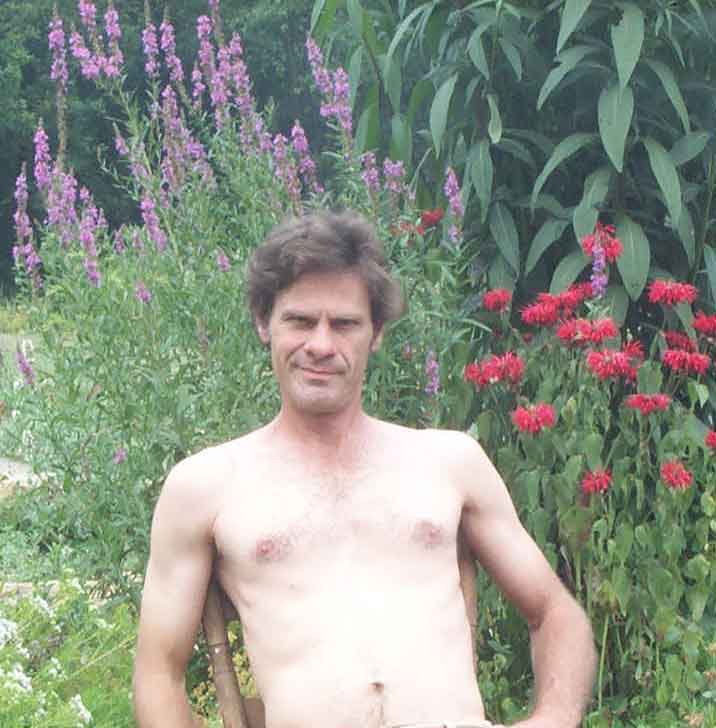
World Naked Gardening Day


September 9 is this year's World Naked Gardening day. How will you celebrate? I'm not sure how I will. I'm somewhat modest and the thoughts of somebody seeing me naked...well I have different thoughts, but mostly feel a bit of shame. There are practical considerations too. Small game season has opened and there are hunters about. There are thorns and yellow jacket wasps too. Still being naked in my garden is something I think I'd like; actually I know I do. Especially on those first warm spring days, I'll admit it I've stripped and laid down naked on a big flat rock in the yard. I've also gotten naked to manage my sunken pots in my little fish pond. Perhaps, I'll do that tomorrow. Except the last time I reached into the pond there was a snake.

Silly, my gardening efforts this season have been as about as assiduous as my recent posting here. The grass has grown so tall that the mower chokes and I've left the weeds go so long in the garden beds that I'm creating mountains of debris as I weeds them. My father dug potatoes today. Oh yes, I'm afraid even the vegetable garden went to pot this year. So it was to my great delight to see nice big firm red Pontiac potatoes being dug. I cooked a couple for supper. I'm not sure why but home -grown potatoes taste better and have a wonderful texture even after long storage.

As easy as it's been to neglect my garden this year, it's been even easier to ignore this blog. But today I got a comment from Sokari of Black Looks and she told me "keep blogging." I'm star-struck! I love Black Looks and I have so much admiration for all the efforts Sokari makes to bring new voices to blogging.

Two recent Black Looks posts are important. Sokari documents the gay baiting of a Kampala tabloid called Red Pepper. In A pact against freedom Solkari writes:
The horrific events taking place in Uganda should be a wakeup call for everyone. People may think that they are safe from harassment and arrest because they are heterosexual. Not so, a witch hunt affects everyone irrespective of their sexuality.
In a previous post Gay Hunt Uganda she provides more information about the current odious campaign of Red Pepper.

I'm not at all sure who you are my dear readers, or how in the world you found this blog. But I'm sure any of you who have perused my posts already know I fit the stereotype of silly mzungu. Nevertheless, I truly do believe that what affects one of us affects all of us. And I believe that using the fantastic new tools that modern information and communications technologies we have have the means to collaborate worldwide is ways never before possible. But communicating across cultures indeed has it's pitfalls, so it's good to be wary of them.

The link to A pact against freedom includes the comments and I want to point to Sokari's response to the comment I left there. She wrote in part:
John - I believe if you go down to Kampala today as a gay man or lesbian you will find yourself at best shunned and at worst beaten or even killed - definately you will not be able to return to your house or job. Please let us listen to what is being said by those who are experiencing it and not what we would like to imagine.
I certainly do agree with the importance of listening. And the implicit notion that I have no idea how bad it really is almost certainly true.

When I was a boy we moved to Greenville, South Carolina. Segregation was still very real. Drinking fountains, separate waiting room, very explicit stuff that even a boy of eight couldn't miss. My dear mother in the year or so before she died got a little dotty. One of my nephews was nearly in tears asking me "Why is Grandma so racist?" As near as I could tell what gave him that impression was her use of the word "colored." I really don't remember now, but it's quite probable the context was offensive too. It hurt me because that impression of her as racist was so off the mark.

In the fifties as a girl scout leader she had made sure that all the meetings of the girl scout leaders were in the one restaurant in the area of western Virginia that served both black and white people. She was among the very small group of white teachers who were the first to teach black students in a public school in the very first Head Start program in South Carolina. Her career as a teacher was always in classrooms with both black and white kids or simply black children.

In Charlotte, North Carolina with an extraordinarily hot and contested desegregation plan she invited all the teachers at the school she was teaching at to a party at our house. That the banker neighbor married to a realtor refuse to speak to us afterward bothered her not one whit. I was bothered by the way my peers treated me; oh that dreaded N word. But nothing in my upbringing gave me any reason to adopt a bigoted response to their taunts. I couldn't find the words to explain to my nephew about his grandmother, because I couldn't find the words to explain what it was like then, the times his grandmother lived. Of course I'm pleased my Southern nephew identifies as an anti-racist. In the scheme of things his grandmother was never a bigot when seemingly everyone else was. Bigotry which was once the norm is now disgraced. Praises be!

In the midst of writing this post I chatted with a friend in Kampala about Sokari's posts. He mentioned that he thinks of the words of Martin Luther King and has a dream for Uganda too. The bigotry of Red Pepper is something he's told me about before. The other evening I chatted with another Ugandan in a different part of the country. She was going to watch Hotel Rwanda yet another time. Certainly the bigotry in the film is a different sort from the gay baiting in Red Pepper. But my friends all tell me how corrosive bigotry is, and it is everywhere and various. No, not everyone sees the hatred and abuse of gay people as bigotry at all. In America it's common to hear the sentiment, "How dare they compare gay right with the civil rights struggle." Yet there are voices who understand that the struggle for fundamental human rights includes human sexualities. And there are those who know that bigoted violence against one is violence against all of us.

Few of us can garden outside naked as much as we might be disposed towards doing so. I can probably get away with it here, at least in some parts of my yard. Some of us may have plants inside our house we can safely tend naked. Still, I'm happy for the naked gardeners because they remind us about freedom and that the bounds of freedom can be stretched. People are encouraged to post their World Gardening Day experiences here. Right now I don't know whether I'll have anything to write. I'll just have to see what the day brings.

Thursday, August 31, 2006

International Blog Day


Ho,ho,it's been a long time since I've written anything here. I suppose it's been a month of rethinking, or perhaps thinking about what I'm doing with this blog. I deleted my last attempt at a post. The topic of the post was something along the lines: You mean to tell me people are supposed to think about what they write? That's my problem, I can't seem to think about what to write in advance. I just open up the handy Blogger window and start typing. Alas, that doesn't serve anyone well, but if I stop to think, I'll probably never post again.

I got plenty of warning that today, August 31st is International Blog Day. And I had planned to post, but in my sloth last night one thing or another came up and I did not. A very cool idea for this event is that bloggers would find five new blogs--preferably blogs written by people in a different place and having a different perspective than you--then write to the bloggers and tell them that you are going to blog about their blogs and do it. There's some other stuff like tagging the post for Technorati so that there will be a comprehensive list of blogday post to search. It's a great idea, but I didn't follow through.

This morning, not feeling particularly bad about my being lazy, I began reading the blogs I do and saw Sokari's post at the always wonderful Black Looks. Sokari did it right and introduces me to five blogs I would never have found without her. All of the blogs she selected are blogs where the individual voices of the bloggers come through. The sometimes peculiar voices of real people is one of the aspects of blogs that I love so much. I'm not so faithful about posting, but I'm addicted to reading blogs.

Here are five blogs I enjoy reading, they aren't new to me, but perhaps will be new to you.

think:lab: Christian Long is a teacher who works for the impressive architectural firm DesignShare which designs learning spaces that live. Christian also manages DesignShare's blog. At think:lab Christian challenges us to imagine and to create learning environments and the posts run the gamut, but especially touch on the ways that new information and communications technologies can make us all lifelong learners. Christian is a great photographer and has a keen eye for beautiful images. He is passionate about how all of us can become actualized persons creating good right where we live and play.

Blahsploitation: This blog is a portal for the family Phil Jones's Synaesmedia projects--check the links in the sidebar. Most of the time posts at Blahsplotation are simply a pithy comment and a link. Phil Jones's is a British programmer living in Brazil. I'm hardly qualified to form an opinion about his programming skills--hardly qualified in any of my opinions--but Jones is brilliant in making known the implications of the wonderful new media made possible by networked information and communications tools. He's genuinely humane and a polymath. Following his links has opened up my eyes to a wide range of issues and opened my ears to many riveting discussions. Besides, his links often point to something beautiful or fun.

we make money not art: There are so many cool blogs and Web sites making any list of the "coolest" would be a daunting task, but we make money not art would always make my short list. Pittsburgh is a fairly provincial American city, and something about being on the Web often reminds me just what a provincial guy I am--some might say hillbilly. But one of the advantages of my locale, as a legacy of the steel industry which once dominated the economic engine of the place, is the diverse population of Europeans who settled here. Regine, the author of we make money not art is staunchly European in outlook. I'm not exactly sure why I mention that, but it has something to do with the impression so many of us Americans have about how forward thinking and innovative we all are. Sadly,no, I'm reminded while reading posts at we make money not art about the coolest and most cutting edge ideas at the intersection of art and technology--and all without the snark.

UNSANE AND SAFE
: I was late to get online and at fifty once online discovered a generation gap I'd been unaware of. In online discussions I came to learn that a there were ideas and a language for sharing those ideas about cultural criticism familiar to a younger generation, but unknown to me. Jennifer Cascadia writes from a perspective of a Zimbabwean translocated to Australia in her early teen years. From the perspective of betwixt and between she cuts through modernism and post modernists rumminations on the nature of what it is to be human. Cascadia is a martial artist and intellectual. What first intrigued me about her posts was the cross-cultural perspective between Africa and the West. Oh yes, that still interests me, but it's her penetrating observations about how we as human beings think that makes her posts "must read." I don't always agree with her analysis, nor do others judging by the comments. The discussions are, however, always engaging.

Vietnamese God
: As lackadaisical as I am about posting to my blog, I'm evangelical when trying to convince others to make their own blogs. I have a couple of online friends from Vietnam and mentioned to them both that they should have a blog. One of my friends is a little older than the other, and the difference of a few years makes a world of difference; the younger of the two is a digital native. He posts a blog at Yahoo!360. He blogs in Vietnamese, and I don't read a word of it. But it's fun that Yahoo!360 is a social networking site and I've gotten connected with his fellow members of the English Club at the university he goes to there. My older Vietnamese friend, like most of my American friends, finds the idea of blogs somewhat embarrassing. In my effort to convince him that blogs are cool, and knowing how much he prides himself on his good English, I sent him a link to Vietnamese God. He wasn't convinced, but I've continued to read Vietnamese God religiously. The author, God Knows works at an upscale restaurant in Ha Noi called Wild Rice. God Knows knows food and presents grand pictures and details about food and life in Ha Noi. Often he provides recipes and always just slightly skewed perspectives on his lovely city.

There are so many wonderful blogs. As many as I read already, I'm always delighted to discover new voices. International Blog Day is a wonderful opportunity for me and all the rest of us to discover new voices in this wonderful new medium.

Sunday, July 30, 2006

Do Something Positive

photo Bob Donaldson, Post-Gazette

Earlier this week a TV panel was discussing the isolation of American opinion from broader opinions shared around the world regarding the Israeli bombardment of Lebanon and one of the commentators said: "Americans live in a media ghetto." I'm not sure I agree really, but the comment rattled me anyway. Skimming through the Sunday paper today, I got the impression that I see things differently than most. I'm not sure that it's a matter of differences of opinion, rather how I paste things together.

Eritrean-born musician/author in the Sunday UK Times zung me a zinger by saying:
“Don’t cry for these people. Don’t cry for me. It doesn’t count. I want to see positive action. It’s not enough to say, ‘How sad, we hope something will change’. Hope is good, but it’s not enough.”
Sobs, I cry from sadness, I cry from frustration. I've got to agree with Senait it doesn't do a whole lot of good. On the other hand when I read so many expressions of enthusiasm for death and destruction, I'm flumoxed. I don't get it.

Turning to the fashion page of the newspaper I was delighted to see the pictures from Dee Blemahdoo's shop in Homestead. I want some African-inspired clothing. I like this picture most because of the hats. I've gotten requests for Party Hats for Potash in fabric. I respond that it could be done. I don't have any intention of making them, first because it would be hard and second I'm pretty sure they'd be no more popular than the paper ones. Still, I like hats, and having momentary misgivings about ripping off Bob Donaldson's photograph thought to post a picture of Wangari Maathai. Something I like very much about Dr. Maathai is she so often wears something big and decorative on her head.

The pictures of hats were a second choice, I wanted to post this interactive map, The World Map of Happiness. It's so cool, but too big a file to post. The map was made by Adrian White, Analytic Social Psychologist, University of Leicester. The Danes come out onto in terms of satisfaction with life. What makes the Danes so damn happy? White notes that happiness is most correlated with health, wealth and education. When it comes to figuring out something positive to do those three suggest what to do and why war makes me so unhappy. War! Good God, Ya'll.

Doing something positive is hard. Over the weekend I attended a meeting about the Africa Project. Without a doubt a productive meeting, but none of the tasks that lay before the group really thrill me. In particular, my stomach churns when it comes to fund raising. Nevertheless, it was great to be at the meeting if for no other reason than to meet Mbao Mwiya-Ngula, Executive Director of Project-Educate improving education in Zambia. Mbao was very kind but relentless in making the group focus on what specific positive actions we intend to do.

Angry Black Bitch
is one of my favorite bloggers. There's much to admire about her. First of all she does a great job blogging about issues in St. Louis where she lives. Another thing is she's always doing something good. But most of all I love to read ABB because: "Now, don't fret...a bitch may be angry but my ass is not unkind (wink)." The bitch--I had a hard time typing that--most certainly is kind. The Rude Pundit gets linked to a lot and yes, I've been there and laughed at what I've read. But, you know, the Rude Pundit is, well--rude, so it's not a frequent stop for me. Nonetheless, taking a summer vacation, the Rude Pundit has assembled a star-studded cast of guest bloggers starting next week. Monday, July 31st Angry Black Bitch and Bitch Phd will double team for a day of "bitchitude." I'm sure to check Rude Pundit out all week long for writing by some of the blogosphere's best women writers.

I'm really not sure what to do in the face of so many problems in the world today, except to try to do something positive. I'm not sure how much help I'll be to the Africa Project, but it was very worthwhile meeting Mbao Mwinya-Ngula who really is getting something done. And the Angry Black Bitch reminds me that passion and feeling go hand in hand with doing good. It's not impossible to improve health, increase wealth, and spread education and in doing so make us all happier.

Saturday, July 29, 2006

Social Money

image(altered)from Good Money

The browser crashed and I lost this post. I hate when that happens! What's so surprising is that while I remember what I wrote about, I don't have a solid memory of what I wrote. Oh well.

My new aquaintance didn't much like my blog, but his criticism was really more general. He wrote about the prospect of his writing:
Maybe someday I'll start a blog,but I don't want to until I have something important to say. I don't want to just express myself, I want to express important ideas and provoke
thought.
I must admit that my approach to putting stuff up has been akin to thinking aloud. I knew from the beginning that my idea for Bazungu Bucks was quite half-baked, but in the process of printing some up, handing some out, and writing about them, I've continued thinking---bet you thought I forgot about Bazungu Bucks.

Recently via the intrepid blogger Phil Jones I discovered BillMonk a Web site that makes keeping track of informal debts and repayments easy. The site even makes keeping track of books and stuff possible. It's easy to imagine many times when this service would come in handy. I thought back to my student digs with multiple roommates and how great it would have been.

Earlier in the month also on Jones' Platform Wars, Phil addressed the difficulty for Web developers have in monetizing their great ideas, here and here. He points out: "the economy is a communication network and money is its protocol." The Internet is a rival platform towards the same end as money. So he makes the observation that the really important question asked about sites like MySpace isn't: "Where's the money?" but rather "Why the money?

Gaurav Oberoi and Chuck Groom the developers of BillMonk helpfully answer the question about their site: "What's your profit motive"
Our service is free to use, and we're adamant about not selling your personal information to Evil, Inc. So what's in it for us?

We believe the "social money" market is huge; friends continually have informal debts and shared expenses, and money flows between them. But because of its informal nature, this market has been largely invisible. We intend to build a product so compelling that it becomes the method of choice for managing social money. With enough users, BillMonk could track millions of dollars in person-to-person transactions.

While the core use of BillMonk is and always will remain free, our revenue model will include collaborating with financial institutions to offer settlement services to this entirely new market.
I'm left scratching my head about specifically how they're going to make money with this really cool idea, but I'm quite certain that "social money" is going to be huge.

Phil Jones observes that TCP/IP (the stuff that makes the Internet possible) is a rival platform to money, and in a rival network to boot. I suppose that even rivals can play together when that suits them, and it seems already there are good examples like BillMonk where hard cash and social money are playing together.

I love Kiva, the Web site that allows lenders to lend to specific entrepreneurs in developing countries. No question if I ever find a way to make some extra money I'll set up an account at Kiva and start lending. In the meantime I simply pay attention to what they're doing and they make it easy to keep abreast through blog posts. This recent post at Kiva Chronicles and a related post at Into Context really caught my attention.

My friend Nathan in Iganga, Uganda is very interested to find ways to use new information and communications technologies to aid in economic development in his community. One of the issues that Kiva faces is dealing with the amount of time consumed by traveling to villages where the entrepreneurs live and work and then getting back to where the computer is. Intermittent electricity and Internet access also causes delays. Their thought is to use SMS from cell phones to send the information to the Kiva Web site, much like a handy feature of BillMonk.

Hash at White African has a really good idea to make cell phones a useful connection to the Internet. Here's the blog post where he introduces the idea and a large size PDF here. Zangu 'Africa's Web" is what they're calling it. The idea is so cool, the way that Hash is preceding to bring the idea into reality is cool too.

I've been intrigued by alternative currencies after reading about Time Dollars. Up on high ground in Western Pennsylvania, I still felt swamped when hurricane Katrina hit New Orleans. My heart went out in trying to imagine just how complicated rebuilding was going to be for everyone. It takes a lot more than money. A Time Dollar Network seemed it might be of assistance, so I dreamed about Big Easy Bucks. New Orleans was still on my mind when I began this blog and hence the idea for Bazungu Bucks.

Yesterday via Christian Long's think:lab I found Donor Choose a site that's a little like Kiva. Teachers post proposals and donors can choose to support specific proposals. The site allows you to sort the proposals in several ways. I choose to look at proposals from Louisiana. Those of you who don't know teachers may not know that teachers spend bucks from their own pockets for school supplies and are adept at "begging borrowing and stealing" supplies. Donor Choose is very worthwhile. Naturally, what many teachers in Louisiana want are books for their kids. Here's a great site for Harrison County in Mississippi, The Dewey Donation System.

Teachers everywhere want books for their kids. Books For Africa is a wonderful organization. One way to support Books for Africa is to purchase books at Better World Books.

Apparently now even Monopoly game players can now purchase properties with a debit card. Perhaps all of this doesn't quite hang together. But the thread I see are new ideas about money brought about by the platform rivalry Phil Jones alerts us to. Cool.

The way I imagine them now, Bazungu Bucks are a "funny" kind of social money. People can earn Bazungu Bucks, one BB for one hour of time in service to African people. The fun part is that people who have Bazungu Bucks might get time or stuff from people who might want Bazungu Bucks, almost like trading stamps.

So far nobody really wants Bazungu Bucks. The first problem is finding it hard to imagine ways to lend their hours of time in service to African people. A second problem is knowing who else has Bazungu Bucks and what they might trade them for. Phil Jones is a polymath and gave me a neat bit of software to keep track and publish who has Bazungu Bucks. That's a workable solution to the second problem. Now for the first, it's a matter of coming up with proposals for what people can do. I'm lazy, but I'll get around to something along those lines.

Social money is gonna be huge.

Tuesday, July 25, 2006

Frilvolous Exclamations

Polaroid by David Pohl

Over the weekend I attended a picnic in support of The Africa Project in Schenley Park, a very familiar park to people who've attended The University of Pittsburgh or Carnegie Mellon University. It rained which probably affected turn-out, still it was great to meet lots of people there. I'm not very good at networking, but I got an email address and promised to send a few links to a fellow I met there. I did that and got some feedback about this blog in the process. As you might gather from the title of this post the feedback wasn't favorable. The great thing about blogs of this sort is they don't really matter much; that is, there are so many blogs out there it's really just a matter of attending to the ones which catch your fancy.

Really, the difficulty I've had recently in posting hasn't been worrying about you, my dear readers, but rather feeling less certain about anything I might say, in particular anything having to do with African issues.

I always enjoy reading Ethan Zuckerman's blog posts, and Is Israel a problem for the Democratic Republic of Congo? addressed the problem of media attention about Africa in an original way. Zuckerman thinks it's important for world citizens to be informed. He suggest that when we read about the Israel/Lebanon conflict and other stories with well-worn preexisting narratives, that we endeavor to seek out a story about Africa in the news. He wrote:
You’ll likely find the news confusing, complicated, incomplete and unhelpful in forming your opinions about how Central Africa can move towards a peaceful future. And that, oddly enough, is a useful first step.
"Confusing," "complicated," "incomplete" and "unhelpful" indeed, I've found all of that. And the big stumbling block for my writing posts is not wanting to add, even in such a small way, to the confusion. But I found Zuckerman's observation that coming to grips with the complexity of issues affecting Central Africa is a useful step towards a peaceful future.

My new acquaintance finds this blog off-putting; the reason for sending him links was our discussion about how little use he has for the Internet in general. That's not changed, but among the links I sent him was Ish Con and that forum caught his attention. The beautiful thing about first steps is they encourage other steps. There was a note of excitement in his email about finding an online forum of people who are exchanging views about ideas he finds important. It's a first step.

My morning paper had an editorial regarding the Sunday elections in the Democratic Republic of Congo. I'm sure like most regional newspapers, the Pittsburgh Post Gazette dosen't expend much ink on African issues, but I'm pleased they don't completely ignore them either. As Zuckerman points out, if Americans want to read news stories about African issues, they'll have to look for them. But that's not so hard to do.

A few Sunday's ago Post-Gazette reporter Ervin Dyer wrote a beautiful piece, What I Learned to Give about his efforts with the children of Lincoln Elementary Technology Academy to raise money for and elementary school in rural Somany, Ghana. Lincoln-Lemmington is a hard part of town. I searched for a link for the neighborhood and an awful lot of the entries on the page results included the word "incidents." It's a safe bet none at the students at Lincoln Elementary are growing up with a silver spoons in their mouths. Dyer wrote about the kids five-week long effort to collect pennies for the school in Ghana:
Every day we should teach society's forgotten children to imagine that they can care, and that through their caring and through their gifts they can change the world. One person at a time.
Kenyan Analyst linked to a story in a women's magazine published in Ghana, Seeds of Hope: Kenyan Children Helping Children. The children of Kemeliet Primary School in Meibeki Valley, Kenya collected maize, eventually 200 bags (each bag weighing 100kg) for children in drought-affected areas of Kenya. Dyer speaks about "teaching the children" but I for one have much to learn from the students of Lincoln Elementary and Kemeliet Primary School.

One word that Zuckerman didn't use regarding reactions to reading African news was overwhelming, but I feel overwhelmed sometimes. For example here's an article I read today at the BBC, Bleak future for Congo's child soldiers. Might I say how much I object to "bleak futures?"

At the Africa Project picnic I met a man from Northern Uganda who is here in the States for a short while. He actually works in Southern Sudan for Catholic Relief Services. He thanked me for all the help I offer. I protested that I don't do nothing, but he insisted that my attention and the attention of so many Americans is important and appreciated.

All of us can play a positive role towards a peaceful world, even when we are unsettled and confused by the news. The children of Lincoln Elementary worked hard to help their fellow primary students in Ghana, and were happy to do it. All it took was someone to ask for their help, and Ervin Dyer was happy to oblige. Ethan Zuckerman is right about the importance of taking that useful first step. A line from Zap Mama's beautiful Nostalgie Amoureuse comes to mind:
We are the winners
If we unclothe our eyes
The scene is not what it seems
The healing waits in our sky.

Hey there! Before you walk away
Show me the smile that says
I’m not alone
You see what you want in me
This crazy life is my home.

Thursday, July 20, 2006

Africa Project Picnic


Via the Pittsburgh Post Gazette Events Calendar:
To fund their support of the children affected by the war in Uganda, The Africa Project of the Thomas Merton Center is holding its first International Soccer & Family Fun Day Picnic.

The event includes food, African dancers, drummers, and ongoing soccer games. Recent stories, drawings, and videos collected from former child soldiers in Uganda will also be shared at the picnic located at the Oval in Schenely Park. $5 suggested donation.
The Africa Project is the result of my friend Peter's hard work on behalf of the children of Northern Uganda. He's always been good about keeping me informed about opportunities to help out, but somehow I never manage to. I'm sure to attend the picnic, and I hope if you're in the Pittsburgh area you'll consider stopping by The Oval Pavillion this Saturday afternoon (July 22).

I was looking for a picture of Schenley Park at Flickr to use with this post. Searching for 'Schenley Park" I happened upon Daniel Weeks" amazing set of Kite Aerial Photographs (KAP) in and around Pittsburgh. The idea of KAP astounds me and some of the shots of the city are quite cool. Weeks provides pictures and descriptions of his equipment and there are sets of KAP taken elsewhere.

The news from Northern Uganda has been coming fast as furious for the last few weeks. The Lord's Resistance Army has entered into peace talks with the government of Uganda. I've been following the news, but am loathe to comment much recognizing the complexity of the issue. A very good collection of news stories about the developments can be found at The Uganda Conflict Action Network (Uganda-CAN)Web site. Click on the July archives for more.

"Wear a bracelet and unite with the Invisible Children." That link goes directly to The Invisible Children bracelet campaign site and there's a short video about the bracelets. If you haven't heard by now Invisible Children is a documentary film about the night commute thousands of children make in Northern Uganda to sleep in the relative saftey of Gulu. The children sleep by the thousands in basements of public buildings, depots and the like, because they fear abduction by the LRA in their home villages. The film is quite moving and if you haven't seen it consider buying the DVD and sharing it with others.

The filmmakers were so moved by the making of the film that they've committed to doing something good for the children of Northern Uganda. That pleases me to no end, but what amazes me stuck in the dinosaur analog era is the way they are using digital technologies to connect people with the children there. The bracelet project is another in a line of interactive ways to address the suffering in Northern Uganda. Each bracelet is a different color and comes with a DVD of a short film telling the story of a real live child in Uganda. In a way the filmmakers have found a way for the audience to participate in the way the story comes out. You can make a difference. Wow these guys are on to something, check out the Web site Invisible Children.

There are many good organizations involved in the issue of child soldiers. Just typing "child soldiers" sends a pang through my heart. I'm sad to admit I've done little. Here's a link to the War Child International Network worth visiting if only to understand that child soldiers are not unique to the LRA in Northern Uganda.

One of the reasons I'm so eager to attend the Africa Project picnic is to meet some of the young people here in Pittsburgh who are trying hard to make a difference there. There really is power in networks. I think we all can find ways to contribute our unique talents to very honorable efforts. It's never been easier to do. We don't have to be millionares, many worthwile efforts don't require giving money. A very good example is Malaria Control.net a computer modeling effort for malaria control. You may have heard of other volunteer computing projects. The idea is that certain problems are so complex they require enormous computing resources. Super computers aren't a dime a dozen, nor are there enough of them to be used for such projects. So volunteer computing is based on the fact that people's personal computers are idle most of the time. A simple computer program allows people to volunteer their computing resources in a giant network for solving complicated modeling projects. It's quite easy, no skin off your back, to help in such a way.

The Africa Project Picnic should be fun. There will be food and the suggested donation is only $5. Hope to see you there. I'll be sure to bring along a stack of Bazungu Bucks to give away. You never know when a Bazungu Buck will come in handy.

Update: I guess I have to be qicker on the draw. The Malaria Control project now has enough computers for their project. However there are other similar projects which you can find out about at the BOINC homepage or wiki.

Friday, July 14, 2006

Hens and Chicks


The picture is a clump of Hens and Chicks growing in the wall by my front door. I've got Hens and chicks growing in dry stonewalls in my garden and the colonies started with a couple of tiny plants haphazardly planted in the rough stone near my little house. The botanical name for them is Sempervivum which means always living. What prompted me to take the photograph was the the rosette going into flower. Sempervium are hardy alpine plants; my careless gardening technique is evidence indeed that they are hardy. The plants are monocarpic, meaning the rosette that sends up a flower stalk will die having completed it's mission, giving lie to the plant's name.

There are so many cultivars and they are so easy, I really should go out of my way to add some cool looking ones to the colonies. There's a good picture of Sempervivum flowers at a page at North Hills Nursery and their collection of cultivars remarkable. I'm rather lazy about being a plant collector, but I encourage the habit in others anticipating gifts from their gardens.

This week my brother-in-law came to visit with two of his grandchildren. I rather like the fact that I'm a great-uncle, but my mind still hasn't wrapped around the idea of grand-nieces and nephews. I remember being a bratty little boy when my brother-in-law was courting my sister, it doesn't seem so long ago. The kids who came to visit are 15 and 13. They remind me that while I have memories of my own teen years, I've forgotten what it's like to be a teenager.

Great fun to watch online activities behind their backs. They love MySpace. I can't figure the place out. I don't think I'm alone in that. I've heard parents complain about their kids and the place and how perplexed they are by MySpace. I didn't learn much by watching them interact with the site and people online, but it sure was fun. It makes me want to check out MySpace a little more and also dozens of other places in the online social networking scene I've been missing. Tonight I downloaded LastFM.

My nephew said he wanted to "pimp my MySpace profile." I sorry now that we didn't get around to that. He said he'd put up a reggae song there. Interesting what that says about the way he imagines me because what kind of music people identify with is extraordinarily important to both my niece and nephew--can't quite manage to say grand. They like emo music. I've often thought what I need is a teenager to guide me through the perplexing online world. But since he left without pimping my profile, I had to explore the the music section on MySpace alone. So cool that there are bands from all over and so many songs to listen to. My friend Pingting who does his illustration work at his computer for long hours sometimes refers to the computer as a "time suck." There is only so much time for attention.

It's been a long time since posting on my blog. I'm out of practice and this post seems awfully hard. There's so much I want to talk about; not posting on my blog doesn't mean I haven't been reading blogs all this time. I've been tuning into all sorts of interesting discussions and of course busy corresponding with my online social network. Parents and more sensible adults than I worry about how Internet rambling cuts into the time for productive activities.

The ever thoughtful Phil Jones in recent posts provides an interesting perspective reframing the subject of productivity. He writes at Platform Wars:
The more effective the internet and the web are at helping us communicate and co-ordinate, the less money will be involved. Because ultimately the economy is a communication network and money is its protocol

The network is not the means to the end of money.

Instead, money and IP are rival protocols in rival networks which are means to the same end : that of articulating human labour to create more wealth for humanity. Money isn't wealth, it's just a kind of signal which can be used to help identify good ideas and channel more resources to them. On the internet we are increasingly finding alternative ways of identifying and signalling what things are worthwhile.
And in a continuing post writes:
Behind all the familiar phrases like "peer production" and "attention economy" and "amateur journalism" is the basic fact : people are being motivated to produce stuff by something other than money.
I have few illusions about how valuable my blog or my other online production are, still they have some "value" but precisely zero monetary value to me. I'm sure my nieces and nephews value their MySpace pages and other online production too.

Like most kids my neice and nephew understand well that money is a communication network. We were going out and the niece wanted to wear the nephew's metal studded belt. "Oh no," he said "I paid thirty dollars for it." I heard arguments about the value of their MySpace pages too: "Why is he your friend and not mine?" The willingness to collaborate on things they were doing on their MySpace pages was prescribed. Both were quick to share "how to" information but loathe to cede any authority on judgments about how the pages should look. Of course the point is to make the pages exactly how they want them.

Most American kids are involved producing stuff to put up on the Internet. People the age of great-uncles less so. We miss something very significant when we imagine Internet use as unproductive. Kids today natively understand the value of Internet production. It's quite a shift in perspective. I've not been very successful in convincing my friends "of a certain age" that participating online is a valuable activity worthy of their attention. As a baby-boomer "the generation gap" was a hot topic in my teens. With the recent visit of my nephew and niece, I'm beginning to see how vast the generation gap is today.